By SourceLab AI Studios — May 2026
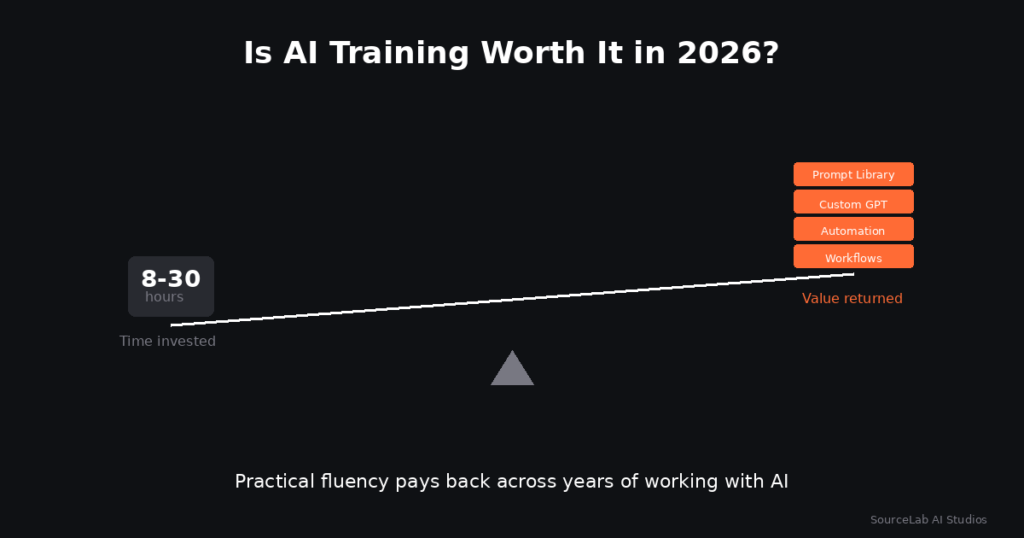
For most working professionals whose jobs involve knowledge work, AI training in 2026 is worth it. The right format produces practical fluency in 8-30 hours of structured practice, and that fluency pays back across years of working alongside AI tools. The honest exceptions: you’ve already built reliable AI workflows on your own, you’re a software engineer with your own learning path, or the program you’re considering is open-format asynchronous with no instructor or facilitator.
The “is it worth it” question depends almost entirely on two variables: who’s asking, and what kind of program they’re evaluating.
Who is AI training worth it for?
The audiences who currently get the most ROI from structured AI training:
- Working professionals in non-technical roles — project managers, operations, HR, marketing, finance, sales, admin. AI fluency is becoming a baseline expectation in many of these roles. McKinsey reports the share of employees using AI at work jumped from 30% in 2023 to 76% by 2025, and the number of jobs explicitly requiring AI fluency grew from about 1 million to 7 million over the same period — a sevenfold increase (McKinsey, 2025).
- Mid-career professionals retooling for the AI economy. Anyone whose company is “implementing AI” and wants to be ahead of the curve, not on the receiving end of it.
- Career changers moving from one domain to another and using AI fluency as the through-line on their resume.
- Managers and leaders who need to make decisions about AI adoption without being technical themselves.
- Parents and educators who want to understand AI well enough to guide the people in their lives.
The audiences who tend to get less out of formal AI training:
- Software engineers — they have their own learning paths (LLM API documentation, agent frameworks, prompt engineering for production). Generic AI training programs aren’t designed for them.
- People who’ve already built reliable AI workflows independently. If you’ve integrated AI into your daily work and the workflows are durable, formal training is mostly redundant.
What’s the actual ROI on AI training?
The most common ROI comes from time savings on recurring tasks. A working professional who spends 90 minutes building a Custom GPT to handle their weekly status reports can save an hour or more per week. Over a year, that’s 50+ hours back. The training paid for itself within weeks.
That’s just one workflow. Most participants in 8-12 session programs leave with several reusable AI assets — not every one saves hours-per-week, but the cumulative effect compounds.
Beyond time savings, the harder-to-measure return is being someone employers want to hire, retain, and promote. As the McKinsey data shows, demand for AI fluency in the workforce is growing fast. Being on the right side of that curve has compounding career value.
Worker sentiment around AI in 2026 splits along a recognizable line: people who’ve actually used AI for real work tend to approach the shift with confidence; people who haven’t tend to approach it with concern. AI training is one of the few practical things a working professional can do to move from the worried column toward the confident one.
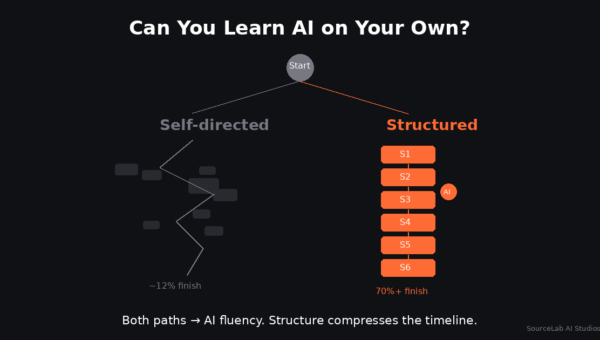
If you go the self-directed route, three things help: a specific motivating problem you’re trying to solve, a peer or community for accountability, and a forcing function (a deadline, a presentation, a project) that requires you to ship something using what you learn.
If you’re not sure you have those three, a structured program is probably worth it.
SourceLab’s worth-it case
SourceLab’s AI Edge track runs 8 sessions of 90 minutes each, completed in 1-2 months. Sessions 1 and 2 are free — the bet underneath the freemium offer is that fluency-producing AI training should prove itself before it asks for payment.
If the bet is wrong, sessions 1 and 2 cost you 90 minutes you would have spent in a meeting that got rescheduled. If the bet is right, you walk out with workflows you keep using.
FAQ
Is AI training a waste of money?
For programs with structure, instructors or agents setting the pace, and concrete deliverables — no. For open-format asynchronous courses with no facilitator, the completion data suggests it often is.
How quickly will I see ROI on AI training?
Most participants in well-structured programs build a workflow in their first session that they start using within 24 hours. The full ROI compounds across months as more workflows accumulate.
Should I take AI training even if my company hasn’t asked me to?
Yes — particularly if your role involves knowledge work. AI fluency is becoming a baseline expectation in many roles, and being early often matters more than being thorough.
Will AI training become outdated?
The tools change fast (the model someone learns to use today will be replaced in 18 months). The underlying patterns — how to evaluate AI outputs, how to design reliable workflows, how to structure prompts — change much more slowly. Good AI training teaches both.
What if I’m starting from zero?
The 8-30 hour range still applies, but the first 2-3 sessions will feel different than they do for people with prior AI experimentation. Structured programs that teach absolute beginners separately from intermediate users tend to produce better outcomes for both groups.
See SourceLab in action
SourceLab’s first two sessions are free — no credit card. You walk in with a real task, you walk out with something built that handles it.
Start your first session free →
SourceLab AI Studios is a neighborhood AI learning center based in Mill Valley, CA. Our 8-session AI Edge track teaches working professionals to use AI tools effectively in their actual jobs. Learn more →. For the broader picture on AI training in 2026, see our pillar guide.