By SourceLab AI Studios — May 2026
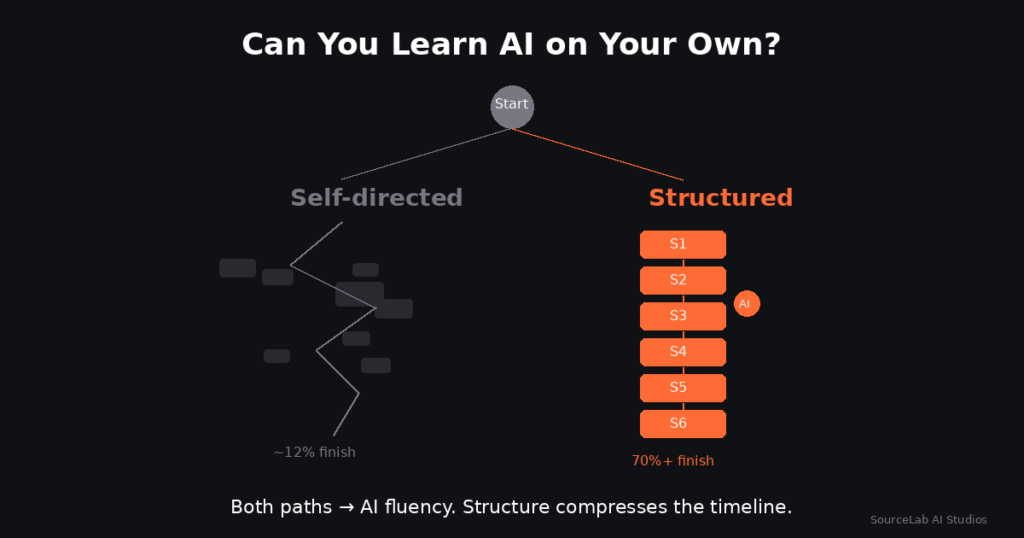
Yes, you can learn AI on your own — and some people do effectively. Self-directed AI learning works when you have a specific motivating problem you’re trying to solve, a peer or community for accountability, and a forcing function that makes you ship something. Without those three, completion data shows most self-directed AI learners don’t finish what they start. Structured training fills that gap. The honest question isn’t “is DIY possible” — it’s “does DIY work for you specifically.”
Most working professionals end up doing some combination of both: self-directed exploration to figure out what they want to learn, then structured training to actually build durable workflows. This guide is about how to tell which path is right for you.
Who actually learns AI well on their own?
Self-directed AI learning works for a recognizable profile:
- You have a specific motivating problem. “I’m a freelance writer who wants AI to handle research” works. “I want to learn AI” doesn’t.
- You’re already comfortable learning new tech tools without hand-holding. If you taught yourself Notion, Airtable, or any other modern SaaS tool to a level where it’s part of your workflow, you have the disposition.
- You have a forcing function. A deadline, a project, a presentation, or a habit (publishing weekly, building one workflow per week) that requires you to actually use what you learn.
- You have a community or peer. Someone to compare notes with, to debug prompts with, to ask “is this normal?” when AI does something weird.
If those four things describe you, DIY is genuinely viable. If two or fewer describe you, the failure mode is almost always the same: enthusiasm in week one, bouncing around tutorials in week two, distraction in week three, never came back in week four.
What self-directed AI learners need
Three structural pieces, in priority order:
- A real problem to solve. Pick one specific task you do regularly and that you’d like AI to handle better. Status reports. Email triage. Meeting prep. Customer support drafts. Something concrete. Self-directed AI learning that starts from a real problem and works backward to the AI tools is durable. Self-directed learning that starts from “let me learn AI” and goes looking for problems is not.
- A learning loop. A pattern you’ll repeat — read a tutorial or post, try the technique on your real problem, notice what worked and didn’t, adjust. The loop matters more than the curriculum. People who run the loop produce fluency; people who collect tutorials don’t.
- A peer or community. Even informally — one or two people you check in with weekly. Could be a friend at work, a Discord, a small mastermind. The accountability matters more than the technical depth of the conversations.
If you can set up those three pieces and protect the time, DIY works. If not, the structure of a paid program is doing real work.
The completion problem (which you should know about)
The reason structured AI training exists is that self-directed learning has a completion problem. Research on MOOC and open-format async course completion has found a median completion rate around 12.6% across studied platforms (Open Praxis, 2024). HarvardX and MITx data showed roughly half of registrants never even start the course they signed up for.
The pattern across the data: when there’s nothing setting the pace, most people don’t finish. That’s not a knock on the learners — it’s a structural property of open-format async learning. The format produces low completion regardless of who’s enrolled.
The same pattern applies to “I’ll learn AI on my own” intentions. Unstructured DIY without the three structural pieces above fails the same way an open-format async course fails: enthusiasm without follow-through, knowledge without application, started but not finished. (For more on what does and doesn’t work for AI training formats specifically, see our pillar guide on AI training in 2026.)
The hybrid approach (most people end up here)
Most working professionals who become AI-fluent don’t do pure DIY or pure structured training — they do both, in sequence:
- Phase 1: Exploration (a few weeks of DIY). Try ChatGPT, Claude, or Copilot on a few real tasks. Read a few credible posts. Get a feel for what AI can and can’t do.
- Phase 2: Structured training (a month or two). Take a structured program with clear deliverables to build durable workflows around your actual job.
- Phase 3: Continuous DIY (ongoing). Use the patterns from training to absorb new tools and techniques as they come out. The training gives you the architecture; your DIY practice keeps it current.
This shape works because each phase plays to its strengths. Exploration is cheap and quick. Structured training is efficient at building workflows. Ongoing DIY keeps you current as the tools shift.
When training fits better than DIY
Five signals it’s time to switch from DIY to a structured program:
- You’ve spent more than a few weeks on YouTube tutorials and still don’t have anything you use daily. That’s the format problem catching up. Switch.
- You’re getting decent results from one tool but can’t generalize to a new task without going back to tutorials. You haven’t built the underlying patterns yet. Structured training accelerates that.
- You don’t have a peer or community for accountability. The training cohort fills that role.
- Your time is more valuable than the program cost. If a $200 program saves you 10 hours of fumbling, the math is obvious.
- You need to actually finish. A specific work deadline, a job interview prep need, a project you’re committing to. Structured pacing makes finishing more likely.
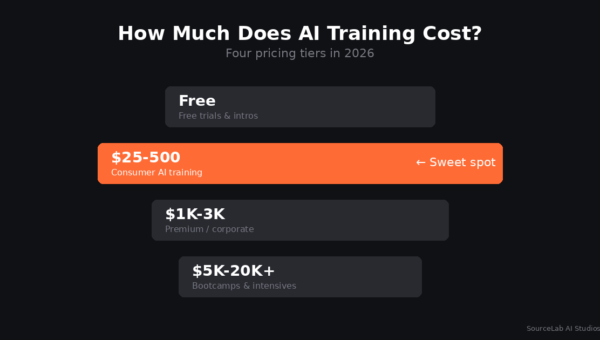
For more on the cost question specifically, see how much AI training costs in 2026.
SourceLab vs. DIY
SourceLab’s AI Edge track is 8 sessions of 90 minutes each. The AI instructor agent paces each session. Each session ends with a real deliverable tied to the participant’s actual work — Session 1 in particular has you bring in one task you need to do (an email, meeting notes, a description, a process doc) and walk out with it done. Sessions 1 and 2 are free.
DIY can produce the same fluency for the right learner, given the structural pieces above. SourceLab compresses the timeline, eliminates the “what do I do next?” question between sessions, and provides the cohort/instructor pacing that the completion-rate research says is the variable that matters most. For working professionals who don’t have time to build their own structure, that’s the trade.
If you go DIY: keep a real problem in front of you, run the learning loop, and find a peer. Those three pieces are most of what structured training adds. Programs are efficient delivery mechanisms for that structure — they’re not magic.
FAQ
Is YouTube enough to learn AI?
For tool literacy, often yes. For workflow integration in your actual job, rarely on its own — the gap between “I watched a tutorial” and “I built something durable for my work” is where most YouTube-only learners stall. Pair YouTube with a real problem and a forcing function, and it can work.
How long does it take to learn AI on your own?
For people who actually finish, the timeline is similar to structured programs — roughly 8-30 hours of practice spread over a couple months. The difference is most DIY learners don’t get to “actually finish.”
What’s the best free way to learn AI?
Take the free first sessions of a structured program (most reputable AI training programs offer them) plus follow a couple of credible practitioners on social. That gets you tool literacy and workflow exposure without paying. If you want to build durable workflows beyond that, paid structure usually pays back fast.
Can self-taught AI learners get jobs in AI?
For non-technical roles where AI fluency is increasingly expected (project management, marketing, ops, etc.), yes — what employers care about is whether you can actually use AI in the work, not whether you took a class. For AI engineering or ML roles specifically, self-taught is harder but possible with a strong portfolio.
Should I take training even if I can learn on my own?
If your time is more valuable than the program cost (most working professionals), training is a faster path to fluency. If you have time, discipline, and a forcing function, DIY works.
See SourceLab in action
SourceLab’s first two sessions are free — no credit card. You walk in with a real task, you walk out with something built that handles it.
Start your first session free →
SourceLab AI Studios is a neighborhood AI learning center based in Mill Valley, CA. Our 8-session AI Edge track teaches working professionals to use AI tools effectively in their actual jobs. Learn more →. For the broader picture, see our pillar guide on AI training in 2026.