By SourceLab AI Studios — May 2026
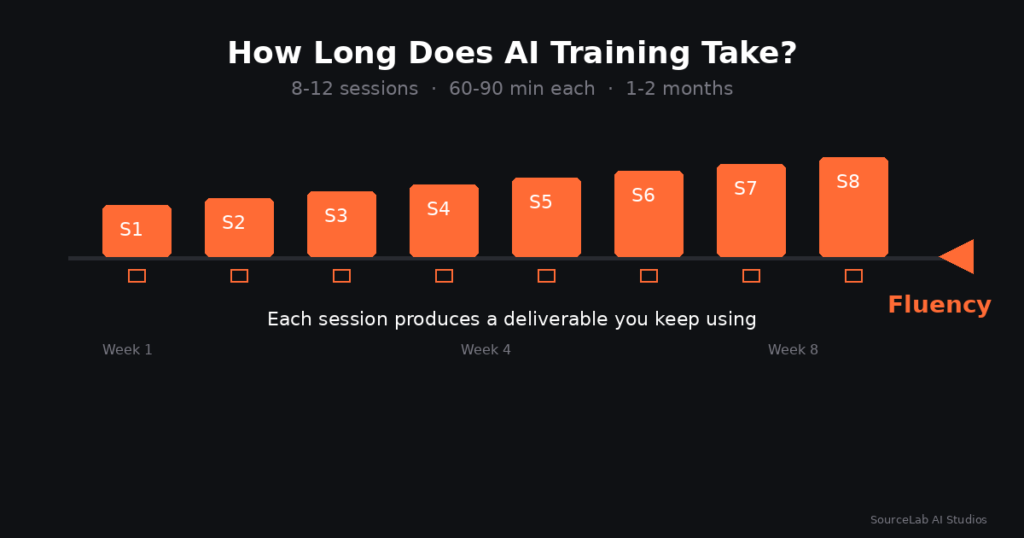
Most AI training programs in 2026 take between 8 and 30 hours of structured practice, spread across 1-2 months for working professionals. The exact duration depends on the format: single-day workshops run 4-8 hours, structured multi-session programs run 8-12 sessions of 60-90 minutes each, and cohort-based bootcamps run 4-8 weeks part-time.
That’s the short answer. The longer answer is that “how long does AI training take” is the wrong question for most people. The better question: how long until I’m fluent enough to use AI in my actual job?
For most working professionals, that’s the 8-30 hour range — but only if those hours are structured around real work, not generic exercises.
What’s the right AI training format for the time you have?
The four most common AI training shapes in 2026, and what each one actually requires:
- Single-day workshops (4-8 hours). Good for tool literacy. Compressed enough to fit a workday or a Saturday. Limited for workflow integration — there isn’t enough time to build something durable that you’ll keep using afterwards.
- Multi-session structured programs (8-12 sessions, 60-90 minutes each, spread over 1-2 months). The dominant shape for working professionals in 2026. Long enough to build real workflows. Short enough that the commitment is manageable alongside a full-time job.
- Cohort-based bootcamps (4-8 weeks part-time). More comprehensive. Better for career-changers and people willing to make AI training a primary focus for a stretch. Harder to fit into a working schedule.
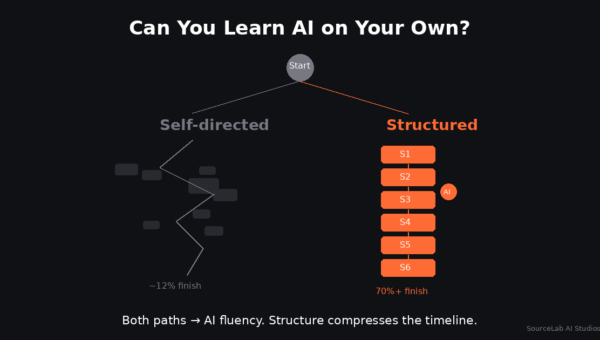
- Open-format asynchronous courses (no instructor, no facilitator, no enforced cadence). Variable in theory. Brutal in practice. Research on MOOC completion has found median completion rates around 12.6% across studied platforms (Open Praxis, 2024), and HarvardX and MITx data showed roughly half of registrants never even start the course they signed up for (Inside Higher Ed, 2019). When there’s nothing setting the pace, most people don’t finish. This is different from agent-paced or facilitator-paced learning — those have someone (or something) keeping cadence, and they perform very differently.
Why 8-12 sessions is the sweet spot for working professionals
Three things make 8-12 sessions of structured practice the most reliable shape for AI fluency in 2026:
Each session can produce a real deliverable. Roughly the right size to scope one useful AI workflow — a Custom GPT for a recurring task, a prompt library tied to one job, an AI-assisted research routine. Smaller scope and the deliverables aren’t durable. Larger scope and the participant gets overwhelmed.
The cadence lets practice compound. Sessions spaced 3-7 days apart give participants time to actually use what they built between sessions. By session 3, they’re not just learning new techniques — they’re refining the things they built in sessions 1 and 2.
The time commitment fits a working life. 60-90 minutes per session, once or twice a week, for 4-8 weeks is a realistic ask for someone with a full-time job. Anything more concentrated tends to fall off when work gets busy.
Why open-format asynchronous courses underperform — and what’s different about agent-paced or facilitator-paced learning
The completion-rate research is the elephant in the room — but it’s worth being precise about which formats it indicts.
The data is brutal on open-format asynchronous courses: prerecorded videos, no instructor, no facilitator, no enforced cadence. Buy access, watch (or don’t), no deliverables anyone is checking. Most people complete 1-3 modules, hit a busy week at work, and never come back. The marketed duration (“learn AI in 30 days at your own pace”) doesn’t reflect what actually happens.
The data does not indict agent-paced or facilitator-paced learning — programs where an AI instructor agent or a human facilitator sets the cadence within each session, where each session ends with a tangible deliverable, and where the participant has someone (or something) keeping them on track. That’s a structurally different format. It looks “self-paced” from the outside because the participant chooses when to take the next session — but inside each session, the pacing is set by the instructor or agent, not left to discipline.
The variable that matters isn’t whether you can take a session whenever you want. It’s whether anything sets the pace once you sit down, and whether the session produces something concrete by the time you finish.
For most working professionals, that’s the format that works.
How fast can you see useful results from AI training?
The general pattern most working professionals hit on a structured timeline:
-
Early sessions (first few hours): A real work task you bring in — an email, meeting notes, a description, a process doc — completed using AI. The point of the first session is to get something useful done in the same room, not to lecture you on theory.
- Mid-track: Building from individual tasks to repeatable workflows — research routines, communication patterns, role-specific tooling. The deliverables get more sophisticated as the foundations compound.
- Late-track: Architecture-level fluency — reusable AI assets and workflow patterns that travel across tools, jobs, and timeframes.
Most working professionals reach the “I use AI fluently at work” threshold somewhere in the middle of a structured 8-12 session program. The “I think about AI architecturally” threshold lands toward the end.
How to plan AI training around a working schedule
Three cadences that work for full-time professionals:
- The lunch-break cadence. 60-minute sessions twice a week during lunch. Easy to defend on the calendar. Total commitment: 6-8 weeks elapsed.
- The weekend-anchored cadence. One 90-minute weekend morning session per week, plus one shorter weekday practice block. Total commitment: 8-12 weeks elapsed.
- The intensive cadence. Two 90-minute sessions per week for 4-6 weeks. Faster elapsed time, more concentrated. Works if you can defend 3 hours/week against your calendar.
The intensive cadence produces fluency fastest but burns out more participants. The lunch-break cadence is the most sustainable.
How long does AI training take at SourceLab specifically?
SourceLab’s AI Edge track runs 8 sessions of 90 minutes each, completed in 1-2 months on a flexible schedule. Within each session, an AI instructor agent paces the participant through the work and ensures a concrete deliverable comes out the other side. Across sessions, the participant chooses when to come back. Sessions 1 and 2 are free — most participants who finish session 2 keep going. For the broader picture on what AI training is and how to evaluate any program, see our pillar guide on AI training in 2026.
FAQ
Can you learn AI in a day?
You can develop tool literacy in a day — enough to use ChatGPT or Claude effectively for some tasks. You can’t build durable workflows in a day. For practical fluency at work, plan on 8-30 hours of structured practice over 1-2 months.
How long is a typical AI training session?
The most common shape in 2026 is 60-90 minutes per session, repeated weekly or biweekly. Shorter sessions (under 45 minutes) don’t have time to produce real deliverables. Longer sessions (over 2 hours) tend to fatigue working adults.
Is a 30-day AI bootcamp worth it?
Depends on the format. A 30-day part-time bootcamp with structured sessions, an instructor or agent setting the pace, and concrete deliverables can work. A 30-day open-format asynchronous “course” with prerecorded videos and no cadence rarely does — the completion-rate research is unforgiving on that format specifically.
Do I have to commit upfront?
Many programs (including SourceLab) offer the first session or two free so participants can evaluate before paying. Use those — they exist for a reason.
What if I’m starting from zero?
The 8-30 hour range still applies, but the first 2-3 sessions will feel different than they do for people with prior AI experimentation. That’s normal. Structured programs that teach absolute beginners separately from intermediate users tend to produce better outcomes for both groups.
See SourceLab in action
SourceLab’s AI Edge track runs 8 sessions of 90 minutes each, with sessions 1 and 2 free. Most participants finish in 1-2 months — at the pace that fits their work calendar.
Start your first session free →
SourceLab AI Studios is a neighborhood AI learning center based in Mill Valley, CA. Our 8-session AI Edge track teaches working professionals to use AI tools effectively in their actual jobs. Learn more about us →. For the broader picture on AI training in 2026, see our pillar guide.