AI training, as of mid-2026, is structured learning that helps a person — usually a working professional with no developer background — use AI tools effectively in their actual job. It’s not coding. It’s not theoretical computer science. It’s the practical fluency to take an AI model like Claude, ChatGPT, or Copilot and turn it into a workflow you actually use Monday morning.
That definition has shifted fast. Two years ago, “AI training” usually meant a developer-focused course on machine learning fundamentals or a corporate compliance webinar about responsible AI use. Today, it more often means a working session where a project manager builds a Custom GPT for status reports, an HR director designs an AI-assisted interview prep workflow, or an operations lead automates a recurring data cleanup task. The audience changed. The deliverable changed. The category shifted with it.
This guide is for anyone — working professional, career changer, manager, parent, or curious adult — trying to figure out what AI training actually is in 2026, who it’s for, and how to tell good programs from bad ones.
What does AI training actually teach?
The honest answer: it depends on the program, and the differences matter more than they look.
Most AI training programs in 2026 fall into one of three buckets:
- Tool literacy programs. These teach the basics of how to use a specific AI tool — usually ChatGPT, Claude, Microsoft Copilot, or Google Gemini. Useful for people who’ve never touched these tools. Limited value for anyone who’s already been experimenting on their own.
- Workflow integration programs. These teach how to embed AI into existing job tasks — automating recurring work, augmenting decisions, building reusable prompts and Custom GPTs around real outputs. The deliverables are workflows, not certificates.
- Foundations and theory programs. These cover how AI models actually work — tokenization, context windows, agents, governance. More technical, more abstract, useful for people who want to make architectural decisions about AI in their organization but who don’t necessarily need to ship code.
A program can mix all three, but most lean on one. The question to ask isn’t “is this program good?” — it’s “which of these three things am I actually trying to learn?”
For most working professionals in 2026, the answer is workflow integration. Understanding transformer architectures isn’t a prerequisite for being more effective at work with AI. What matters is knowing what tasks AI handles well, which tasks it handles poorly, how to design prompts that produce reliable output, and how to stitch AI into the work you already do.
Who is AI training for?
Anyone whose job involves text, decisions, research, communication, or pattern recognition — which, in 2026, is most knowledge work.
The audiences who currently get the most out of structured AI training:
- Project managers, operations, HR, marketing, finance, sales, admin, and similar non-technical professionals who want AI in their daily workflow without becoming developers.
- Mid-career professionals retooling for the AI economy — people who’ve been told their company is “implementing AI” and want to be ahead of the curve, not on the receiving end of it.
- Career changers moving from one domain into another and using AI fluency as the through-line on their resume.
- Managers and leaders who need to make decisions about AI adoption for their teams and want to understand what’s real versus what’s vendor pitch.
- Parents and educators who want to understand AI well enough to guide the people in their lives.
The audience that gets the least out of structured AI training — at least the kind aimed at non-developers — is software engineers. They have their own learning paths (LLM API documentation, agent frameworks, prompt engineering for production systems) that don’t overlap much with what working professionals need.
How is AI training different from older skills training?
Three differences that matter:
1. The deliverable is something you keep using. Older corporate training — Excel certifications, project management courses — produced certificates and possibly skills, but the impact often faded. Effective AI training in 2026 produces actual workflows: a prompt library tied to a specific job, a Custom GPT that handles a recurring task, an automation run weekly. People finish the program with assets they continue to use.
2. The pace of change is fundamentally different. AI training is more like sailing than driving — the goal is learning to navigate a system that’s changing underneath you. The model someone learns to use today will be replaced in 18 months. The platform they’re prompt-engineering against will add or deprecate features. Good AI training teaches the underlying patterns (how to think about AI, how to evaluate outputs, how to design reliable workflows) — not just the surface-level features of one tool that won’t exist in two years.
3. The threshold for “fluency” is lower than people expect. AI fluency, in 2026, doesn’t mean understanding how the model works. It means knowing what AI is good at, what it’s bad at, when to trust an output, when to verify it, how to structure prompts, and how to design workflows that include AI as one component. Most working professionals can reach a useful level of fluency in 8-12 sessions of structured practice — that’s the shape SourceLab and several similarly designed programs have settled on, and it tracks with what’s been observed across the industry.
How long does AI training take?
The short answer: between 8 and 30 hours of structured practice gets most working professionals to a useful level of fluency.
Specific program shapes vary:
- Single-day workshops: 4-8 hours. Good for tool literacy. Limited for workflow integration — there isn’t enough time to build something durable.
- Multi-session structured programs: 8-12 sessions of 60-90 minutes each. Most common shape in 2026. Enough time to build real workflows without becoming a months-long commitment.
- Cohort-based bootcamps: 4-8 weeks of part-time work. More comprehensive but harder to fit into a working schedule.
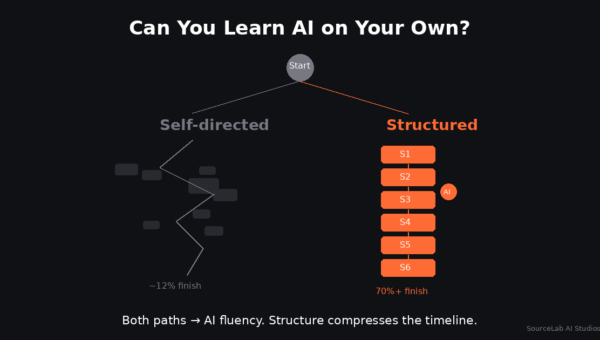
- Open-format asynchronous courses (no instructor, no facilitator, no enforced cadence): Variable. The honest issue is completion. Research on MOOC completion rates has found a median completion rate around 12.6% across studied platforms, with many free or low-cost courses finishing below 10% Open Praxis, 2024. HarvardX and MITx data showed roughly half of registrants never even start the course they signed up for Inside Higher Ed, 2019 The pattern across the data: when there’s nothing setting the pace, most people don’t finish.
It’s worth being precise about what “self-paced” actually means. A course where you watch recorded videos at your own speed with no instructor, no agent, and no deliverables is a different beast from one where an AI instructor agent or human facilitator paces you through structured sessions on a schedule that fits your life. The first format is the one the research is brutal on. The second — agent-paced or facilitator-paced learning, structured but flexible — is what produces actual fluency.
For most working professionals, the shape that works is structured but flexible: 8-12 sessions, each producing a specific deliverable, with an instructor or agent setting the pace within each session, spaced over 1-2 months so the practice has time to compound.
For a closer look at the timeline question — workshop, multi-session, bootcamp, and async formats compared — see our deeper cluster post: How long does AI training take?
How to evaluate an AI training program
Five questions to ask before signing up for any AI training program:
- What does each session produce? A program where every session produces a specific deliverable — a prompt library, a Custom GPT, an automation, a worked example — is more likely to produce real fluency than one that produces only “learning.” If the answer is vague (“you’ll learn about prompt engineering”), keep looking.
- Who teaches it, and what’s their experience? Look for instructors (human or AI agent) who actually use AI in production work. A facilitator whose only experience is teaching the course is a yellow flag.
- How current is the curriculum? AI moves fast. A curriculum written 18 months ago may reference tools that have been replaced or features that have changed. Look for programs that show recent updates or that openly acknowledge what’s changed in the past 6-12 months.
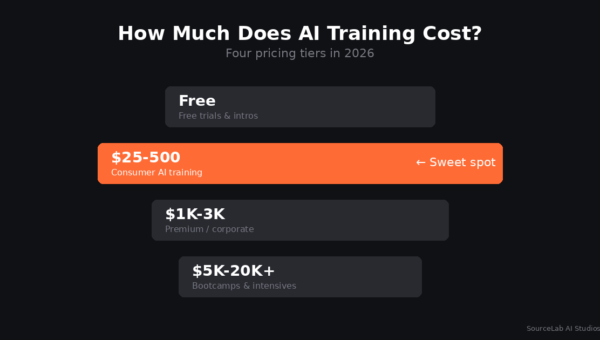
- What does it cost, and what’s free? Pricing in 2026 ranges from genuinely free (with quality varying) to several thousand dollars for executive coaching. Many programs offer free first sessions so you can evaluate before committing. Use those — they exist for a reason.
- What’s the support structure? AI training is most effective with peer cohorts, asynchronous Q&A, or office-hours-style follow-up. Programs that are pure broadcast (record once, stream forever) tend to underperform programs with any kind of feedback loop.
What good AI training looks like in 2026
The most effective AI training programs in 2026 share a few features:
- Builds, not lectures. Every session ends with something the participant takes home and continues to use.
- Structured around real work, not around the tool. The starting point is the participant’s actual job — not the AI tool’s feature list.
- Teaches the architecture, not just the surface. Good AI training in 2026 increasingly teaches participants to build their own context layer (the AI knows about their work, their preferences, their decisions) and governance layer (what their AI is allowed to do, what gets reviewed). That personal architecture travels with the participant across any AI tool, any job, any decade.
- Honest about what AI can’t do. AI is probabilistic, not deterministic. It hallucinates. It can be confidently wrong. Programs that gloss over this produce overconfident graduates. Programs that teach participants to evaluate outputs and verify critical claims produce careful ones.
- Designed around momentum. The hardest part of learning AI isn’t the AI — it’s motivation. Programs that produce momentum (visible progress, real wins, peer accountability) outperform programs that don’t, regardless of curriculum quality.
Common AI training mistakes
What doesn’t work, based on what’s been observed across programs in 2026:
- Watching tutorials without building. YouTube has thousands of hours of AI content. Almost none of it produces fluency on its own, because watching and doing are different cognitive activities.
- Trying to learn everything at once. AI is a wide field. Programs that try to cover machine learning theory, multiple LLM tools, agent frameworks, AI ethics, and workflow design in one course leave participants overwhelmed and underequipped.
- Treating AI as a search engine. Many beginners ask AI questions the same way they’d ask Google. AI rewards a different prompt style — context-rich, role-explicit, output-formatted — and the gap between “good prompt” and “weak prompt” is much larger than between “good search query” and “weak search query.”
- Skipping the verification step. AI outputs can be wrong. Programs that don’t teach participants to verify, check sources, and pressure-test outputs produce overconfident users.
How AI training fits into the bigger picture
The reason AI training matters in 2026 isn’t that AI will take everyone’s job. It’s that the people who become fluent with AI early will produce more — and have more agency in how they use AI — than those who don’t.
The shift has been fast and measurable. McKinsey reports the share of employees using AI at work jumped from 30% in 2023 to 76% by 2025, and 91% of employees now say their organizations use at least one AI tool (McKinsey, 2025). The number of workers in occupations where AI fluency is explicitly required grew from about 1 million in 2023 to roughly 7 million in 2025 — a sevenfold increase in two years.
A common reframe that’s emerged in the past year: AI doesn’t replace people, but people who use AI tend to outpace people who don’t. That oversimplifies the dynamic, but it captures the directional truth. The professionals who can fluently use AI to augment their existing expertise are the ones companies want to hire, retain, and promote. AI training is the on-ramp.
It’s worth being honest about how the workforce feels about this. Worker sentiment around AI in 2026 splits along a recognizable line: people who’ve actually used AI for real work tend to approach the shift with confidence; people who haven’t tend to approach it with concern. AI training is one of the few practical things a working professional can do to move from the worried column toward the confident one: not by ignoring the disruption, but by building real fluency with the tools driving it.
A useful way to think about what AI training actually builds: AI tools (Claude, ChatGPT, Copilot, Gemini) are like power tools. They’re useful, but they don’t run on their own. They need a battery — the personal architecture you build around them: the context that knows what you do, the governance that decides what you let AI handle, the workflows that put it to work. AI training, done well, is the practice of building that battery.
The AI tool gets replaced every two years. The battery built around it doesn’t.
SourceLab’s approach
SourceLab AI Studios
is one of the programs working in this space. Our 8-session tracks produce real deliverables tied to participants’ actual jobs — from a completed work task in Session 1 (an email, meeting notes, a description, a process doc) to more sophisticated workflows and a Custom GPT in later sessions. Audiences run from working professionals AI Edge to displaced tech workers AI Relaunch to parents and teens. Sessions 1 and 2 are free for any track.
That’s our shape. Other programs work differently and may fit a given situation better. The five questions earlier in this guide are how we’d evaluate any program — including our own.
FAQ
Is AI training worth it in 2026?
For most working professionals whose jobs involve knowledge work, yes — fluency with AI tools is becoming a baseline expectation in many roles, and structured training accelerates the timeline from “occasional ChatGPT user” to “daily AI-assisted worker” considerably. The specific value depends on the program and the participant’s starting point.
How long does AI training take?
Most structured programs run 8-12 sessions of 60-90 minutes each, spaced over 1-2 months. That’s the shape that produces fluency for most non-technical professionals. Single-day workshops produce less durable results.
Do I need to know how to code to take AI training?
No. Most AI training in 2026 is designed for non-developers. The tools (Claude, ChatGPT, Custom GPTs) don’t require programming. If a program assumes coding background and you don’t have it, that program is probably not designed for you.
What’s the difference between AI training and an AI bootcamp?
Bootcamp” usually implies a more intensive, coding-adjacent format aimed at career changers becoming AI engineers or ML specialists. “AI training” is broader and increasingly oriented toward non-developers learning to use AI tools at work. (For a side-by-side breakdown, see our cluster post: AI training vs. AI bootcamp — what’s the difference?
How do I know if an AI training program is actually good?
The five questions earlier in this guide — what each session produces, who teaches it, how current the curriculum is, what it costs, and what support is available — are the most reliable filters.
Is AI training the same as AI literacy?
Not exactly. AI literacy is foundational understanding of AI as a technology and its societal implications. AI training, as the term is most commonly used in 2026, is the practical skill of using AI tools effectively. Both matter; they’re different.
See SourceLab in action
The fastest way to see what AI training looks like in practice is to take a session. SourceLab’s first two sessions are free — no credit card. You walk in with a real task, you walk out with something built that handles it.
Start your first session free →