By SourceLab AI Studios — May 2026
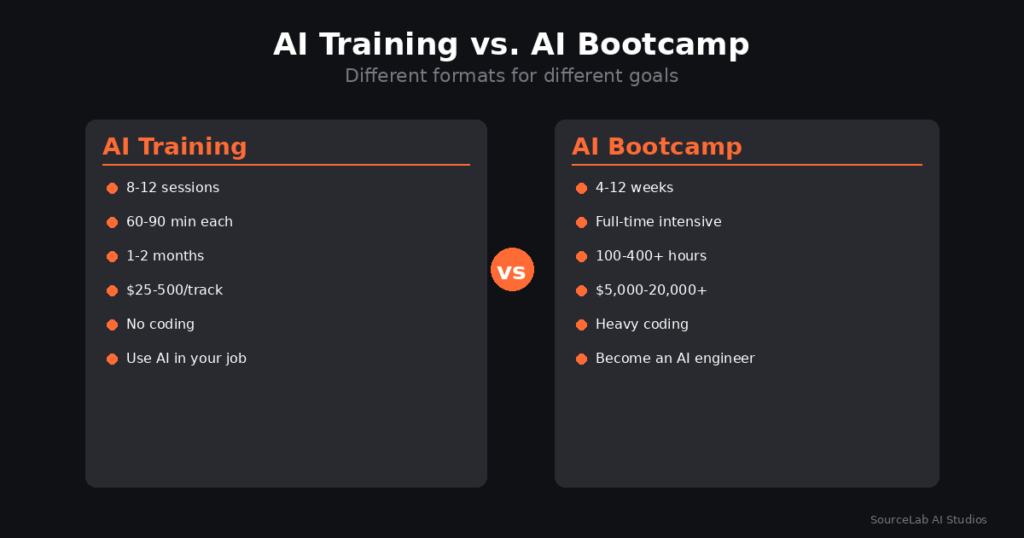
In 2026, “AI training” and “AI bootcamp” usually refer to two structurally different programs aimed at different people. AI training is shorter, less intensive, and aimed at non-technical working professionals learning to use AI tools effectively in their existing jobs — typically 8-12 sessions of 60-90 minutes each, spread over 1-2 months, with a focus on workflow integration. AI bootcamps are more intensive, longer, and aimed at career-changers becoming AI engineers or ML specialists — typically 4-12 weeks full-time or extended part-time, with a focus on coding skills and ML fundamentals.
The terms get used interchangeably in marketing copy, but the programs they describe rarely overlap. Choosing the wrong format wastes months of time and a lot of money. Here’s how to tell which one is which, and which one fits your situation.
What AI training and AI bootcamps actually teach
The skills are different categories, not different levels of the same skill.
AI training (for working professionals) teaches you to use AI tools effectively in your existing job:
- How to design prompts that produce reliable output
- How to build reusable AI assets (prompt libraries, Custom GPTs, automations)
- How to embed AI into recurring workflows you already do
- How to evaluate AI outputs and verify critical claims
- How to think about the architecture around AI tools — context, governance, deliverables
You don’t write code. You don’t learn machine learning theory. You don’t deploy production systems.
AI bootcamps teach you to build AI systems:
- Python and ML libraries (scikit-learn, PyTorch, TensorFlow)
- Machine learning fundamentals (regression, classification, neural networks)
- Working with LLM APIs (OpenAI, Anthropic, Google)
- Agent frameworks and production deployment
- Sometimes data engineering, MLOps, and model evaluation
You write code. A lot of code. The career outcome is being an AI engineer, ML engineer, or data scientist.
The audience difference
| Question | AI training | AI bootcamp |
|---|---|---|
| Who’s the target? | Working professionals (PMs, marketers, ops, HR, sales, admin) using AI in their existing role | Career-changers transitioning into AI/ML engineering roles |
| Coding background needed? | No | Yes (or willingness to learn fast) |
| Time commitment | 8-30 hours over 1-2 months | 100-400+ hours over 4-12 weeks |
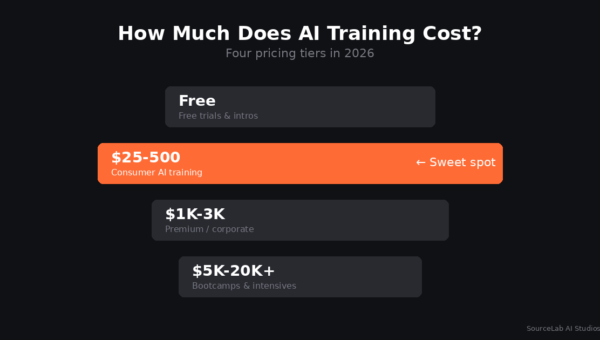
| Cost (typical 2026) | $25-500 per track | $5,000-20,000+ |
| Career outcome | Same job, more effective | New job, new field |
Both formats are valuable. They’re just for different people.
When to pick AI training
AI training is the right choice if:
- You’re employed in a non-technical role and want to use AI in your existing job
- You don’t want to (or have time to) become a developer
- You need ROI you can apply at work next Monday morning
- The change you’re making is “augment my current work,” not “switch careers”
This is the audience the McKinsey workforce data is pointing at — the millions of jobs in 2026 that now expect AI fluency from non-technical workers. AI training is the on-ramp.
For more on what AI training looks like in 2026 and how to evaluate any program, see our pillar guide. For a closer look at whether the investment makes sense for you, see is AI training worth it in 2026.
When to pick an AI bootcamp
AI bootcamps are the right choice if:
- You want a career change into AI/ML engineering specifically
- You’re willing to invest months of full-time or significant part-time effort
- You have (or are willing to develop) the foundational technical skills — math, statistics, programming
- You’re prepared to spend $5,000-20,000+ and possibly take time off work
- Your goal is “be an AI engineer,” not “use AI in my work”
The bar is higher and the commitment is bigger, but the career change is real for people who finish.
How to tell which format a program actually is
The marketing language for both formats can sound similar in 2026, so it’s worth checking the curriculum directly before signing up. A few reliable signals:
- The curriculum teaches Python or ML libraries → bootcamp territory.
- The curriculum teaches prompt design and workflow integration without coding → AI training territory.
- The program runs 4+ weeks full-time or 8+ weeks part-time → bootcamp territory.
- The program runs 8-12 sessions of 60-90 minutes spread over 1-2 months → AI training territory.
- The deliverable is a portfolio of code projects → bootcamp territory.
- The deliverable is a set of reusable workflows tied to your existing job → AI training territory.
If a program is described as “non-technical” but the curriculum includes Python or ML libraries, ask the program for a clearer breakdown — that’s a hybrid format, and your fit depends on whether you want some coding exposure or want to stay strictly non-technical.
Both formats are legitimate. The mismatch problem isn’t about one being better than the other — it’s about picking the format that actually matches your goal.
How to choose between them
Three questions filter the decision quickly:
- What’s your career goal? If it’s “use AI better in my current role,” AI training. If it’s “become an AI engineer,” bootcamp.
- How much time and money can you commit? AI training: 8-30 hours, $25-500. Bootcamp: 100-400+ hours, $5,000-20,000+.
- Are you willing to write code? Yes → bootcamp is on the table. No → AI training is the only option that actually works for you.
If the answers all point to AI training, that’s your answer. If they all point to bootcamp, that’s your answer. If they’re split, the safer move for working professionals is AI training first — you can always escalate to a bootcamp later if the work pulls you in that direction.
SourceLab’s lane
SourceLab’s AI Edge track is in the AI training category — 8 sessions of 90 minutes each, completed in 1-2 months, no coding required. The deliverables are workflows working professionals use in their actual jobs. If your goal is using AI in your existing role, that’s the format fit.
If your goal is becoming an AI engineer or ML specialist, you want a bootcamp — there are good options across the market for that career change. AI Edge isn’t designed for that path, and we’d rather you land on the right program for your goal than get partway through ours and realize the fit is wrong.
(For more on what AI training is and how to evaluate any program, see our pillar guide on AI training in 2026.)
FAQ
Is an AI bootcamp better than AI training?
Better for what? Bootcamps produce AI engineers; AI training produces AI-fluent professionals in their existing roles. Different goals, different “better.”
Can I take an AI bootcamp without coding experience?
Most reputable AI bootcamps require some Python or programming background, or they include a substantial pre-work phase to build it. If you have zero coding experience and no interest in developing it, AI training fits better.
How long does each take?
AI training: 8-30 hours over 1-2 months. AI bootcamp: 100-400+ hours over 4-12 weeks (or longer if part-time).
Can I do AI training first, then a bootcamp later?
Yes — and many people do. AI training builds practical fluency that makes the bootcamp’s higher-level content land better. It’s also a lower-cost way to find out whether the deeper technical path is something you actually want.
Will an AI bootcamp guarantee me a job?
No reputable program guarantees jobs. Some have job placement support, but the outcome depends on the market, your portfolio, and many factors outside the bootcamp’s control. Be skeptical of anyone who promises otherwise.
See SourceLab in action
SourceLab’s AI Edge track is 8 sessions of 90 minutes each, completed in 1-2 months. No coding required. Sessions 1 and 2 are free.
Start your first session free →
SourceLab AI Studios is a neighborhood AI learning center based in Mill Valley, CA. We teach working professionals to use AI tools effectively in their actual jobs — the AI training side of the AI training vs. AI bootcamp question. Learn more →.