By SourceLab AI Studios — May 2026
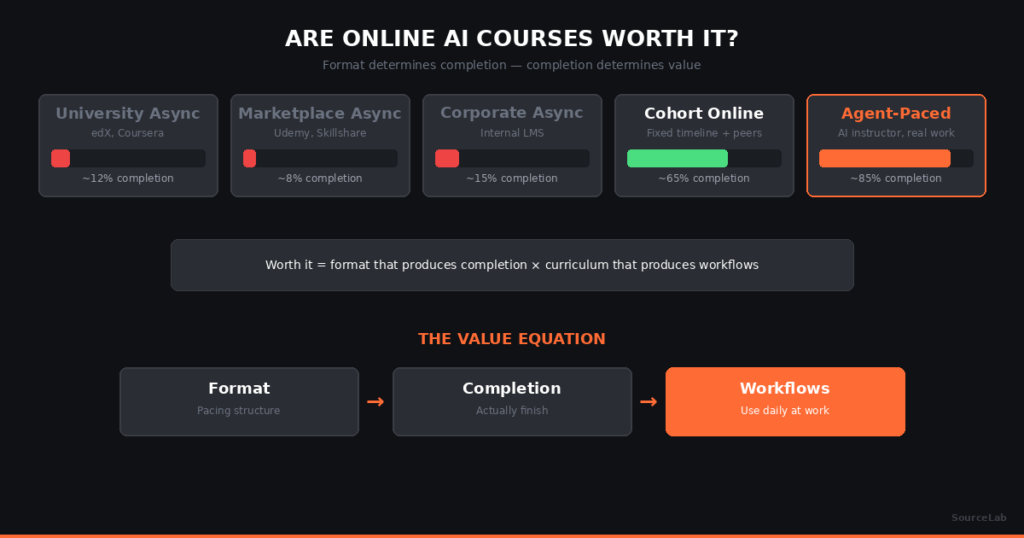
Whether an online AI course is worth it in 2026 depends almost entirely on which online format you’re considering. “Online AI course” covers at least five structurally different things — university-style async (Coursera, edX), marketplace async (Udemy, Skillshare), corporate async (LinkedIn Learning), cohort-based online (Maven, Section, Reforge model), and agent-paced (an emerging format). Each performs differently. The completion-rate research is brutal on open-format async regardless of provider, and much more favorable on structured online formats — meaning two courses with similar titles and pricing can produce wildly different outcomes. The format you pick matters more than the platform brand.
This post is specifically about the online format trade-offs. For the broader worth-it question across all training formats (including in-person and bootcamps), see is AI training worth it in 2026.
What “online AI course” actually means in 2026
Five distinct online-course formats often grouped under the same label:
- University-style async (Coursera, edX, FutureLearn). Recorded lectures + reading + quizzes from credible university providers. Strong content quality; open-format async completion dynamics (more on this below).
- Marketplace async (Udemy, Skillshare, Domestika). Practitioner-recorded courses, variable quality, low price point, no enforced structure. Same completion dynamics as university async, with more variance in content quality.
- Corporate async (LinkedIn Learning, Pluralsight). Subscription-based libraries of practitioner-recorded content. Good for browsing across topics; weak for building durable fluency in any single one.
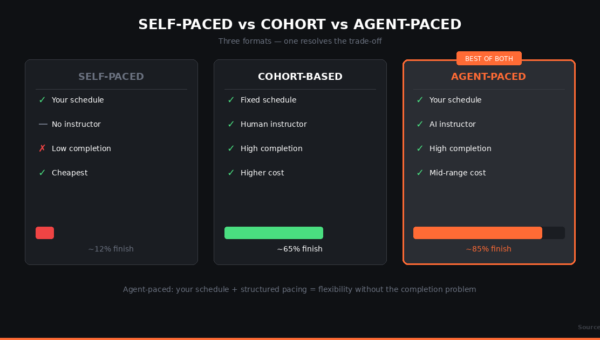
- Cohort-based online (Maven, Section, Reforge model; live cohort programs). Synchronous online sessions with a real cohort, instructor-led, fixed schedule. Much higher completion. Higher price point.
- Agent-paced online (emerging format). AI instructor agent paces individual sessions while learner sets cross-session schedule. Pacing structure of cohort with the flexibility of async.
The “is it worth it” answer differs across these because the formats produce different completion outcomes, not because the content is different.
What the completion data actually says
The variable that determines value in any online course is whether you finish it. Research has found a median completion rate around 12.6% across studied open-format async platforms (Open Praxis, 2024). HarvardX and MITx data showed roughly half of registrants never even start the course they signed up for (Inside Higher Ed, 2019).
That data is specifically about open-format async — university async, marketplace async, and corporate async all share the structural pattern that produces low completion. Cohort-based and agent-paced online formats don’t have the same problem because the format does the pacing.
The implication: a $300 course you finish is worth more than a $0 course you don’t, regardless of which is “cheaper” on the price tag.
Which online formats are worth it in 2026?
A blunt take by format:
- University-style async is worth it as audit-mode reference material (free or low-cost foundational content) but rarely worth paying for the certificate. The completion problem applies.
- Marketplace async is worth it for solving specific narrow problems (a single Udemy course on a specific tool, completed in a weekend). Rarely worth it for building broad AI fluency.
- Corporate async is worth it as part of an employer-provided subscription if you’re already using the platform for other learning. Standalone, the format issue dominates.
- Cohort-based online is worth it if your schedule can accommodate fixed sessions and you value peer accountability. Strong completion; higher price.
- Agent-paced online is worth it for working professionals who need pacing structure without schedule lock. Designed specifically to address the format issue.
For more detail on the format question, see self-paced vs. cohort-based AI courses.
When online AI courses aren’t worth it
Three honest exceptions:
- You’ve stockpiled enrollments without finishing any. The next course isn’t the problem. The format is. Switch to a structured format before paying for more content.
- You’re paying for the certificate. Most employers don’t ask about AI certificates in 2026; they ask “how have you used AI in your work?” Pay for fluency, not credentials.
- The program’s curriculum is more than 18 months stale. AI moves fast. A 2024 curriculum may reference tools that have been replaced. Recency matters.
How to evaluate a specific online course
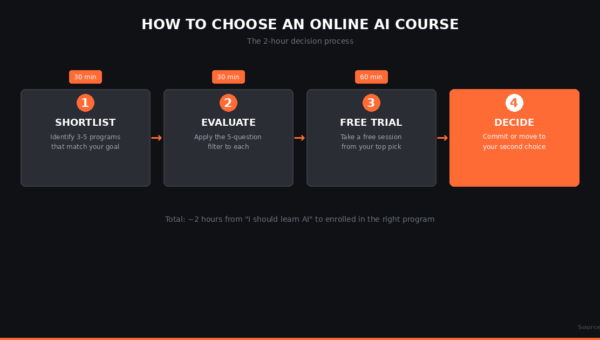
Two practical filter questions for any online course you’re considering:
- Will I actually finish this? Match the format to your discipline. If you have a track record of finishing open-format async courses, that format is fine for you. If you don’t, pick a format with external pacing.
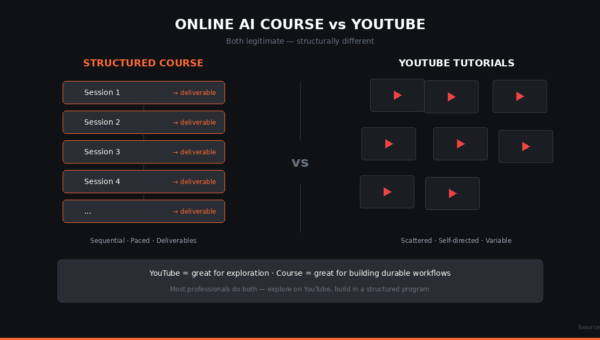
- What’s the concrete deliverable from each session/module? A course where each unit produces something usable beats a course that produces only knowledge. Vague learning objectives (“you’ll understand prompt engineering”) are a yellow flag.
For the full framework, see how to choose an online AI course.
SourceLab’s online format
SourceLab’s AI Edge track is agent-paced online — eight 90-minute sessions, paced by the AI instructor agent within each session, scheduled across sessions by the participant. Sessions 1 and 2 are free; $25/session or $175/track after that. The format is designed specifically for working professionals who need structure but can’t lock to fixed cohort schedules.
That’s our shape. For a comparative view across all the online formats, see our pillar guide on online AI courses.
FAQ
Is Coursera worth it for learning AI?
For free audit-mode use as reference material, yes. For paid certificate paths, the completion-rate data suggests most learners don’t finish. If you have unusual self-direction, fine. Otherwise, prefer formats with external pacing.
Is Udemy worth it for AI courses?
For solving a specific narrow problem with a single weekend course, often yes. For building broad fluency, rarely — the format issue dominates.
Is LinkedIn Learning worth it for AI?
If your employer covers the subscription and you’re already using LinkedIn Learning for other things, the marginal AI use is worth it. Standalone, the format produces the same completion issues as other corporate async.
Are cohort-based online AI courses worth the higher price?
For learners who can attend fixed-schedule sessions, often yes — the completion-rate gap usually justifies the price differential. For learners with unpredictable schedules, the schedule lock undermines the value.
What’s the biggest mistake people make with online AI courses?
Choosing on price or platform brand rather than format. Cost per finished course is the metric that matters, not headline price.
See SourceLab in action
SourceLab’s first two sessions are free — agent-paced, no credit card, 90 minutes each.
Start your first session free →
SourceLab AI Studios is a neighborhood AI learning center based in Mill Valley, CA. Our 8-session AI Edge track teaches working professionals to use AI tools effectively in their actual jobs. Learn more →. For the broader picture, see our pillar guide on online AI courses in 2026.