By SourceLab AI Studios — May 2026
The right online AI course in 2026 is the one that matches your specific goal — practical fluency at work, a career change into AI engineering, exploration as a curious adult — paired with a format that actually produces that outcome for someone with your discipline and time budget. The “best” question is harder than it looks because the category includes everything from $20 Udemy videos to $20,000 cohort programs, and a course that’s perfect for one person fails another. This guide breaks down the formats, the questions that matter, and how to evaluate a program before you spend a dollar.
The online AI course market exploded between 2023 and 2025. McKinsey reports that AI usage at work jumped from 30% to 76% over those two years, and the number of jobs requiring AI fluency grew sevenfold (McKinsey, 2025). Demand for online AI courses followed. The supply caught up fast — and unevenly.
What counts as an “online AI course” in 2026?
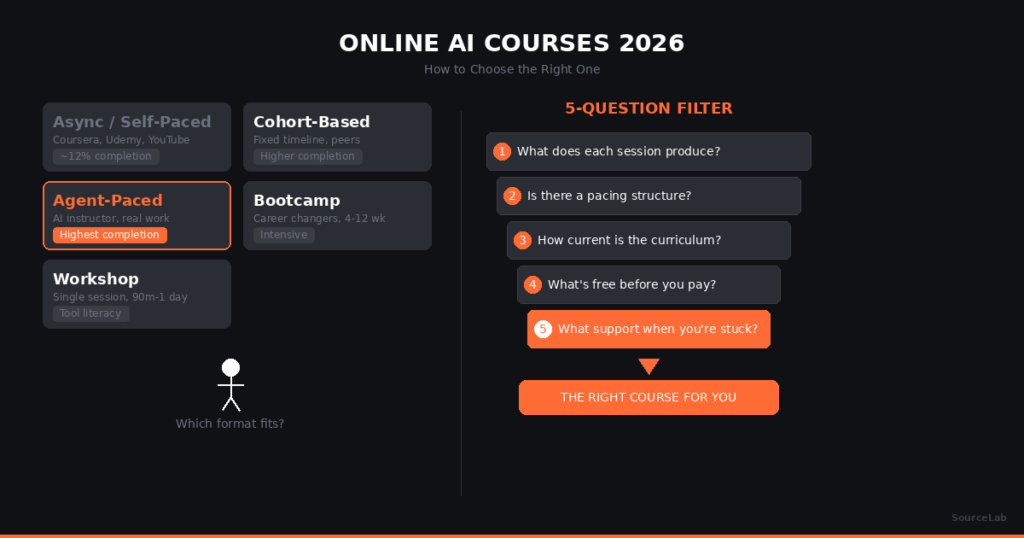
The category is wider than the term suggests. Five formats currently fall under “online AI courses”:
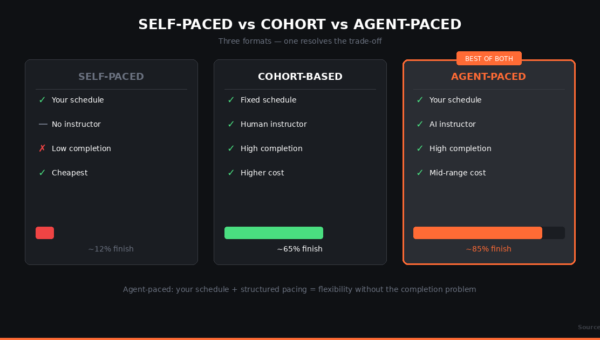
- Open-format asynchronous courses — prerecorded videos, learn at your own speed, no instructor or facilitator. Coursera, Udemy, edX, and most YouTube curricula sit here. Cheap or free, scale infinitely, but completion rates are brutal.
- Cohort-based programs — synchronous group learning over a fixed timeline (4-12 weeks), with a human instructor and a peer cohort. Higher cost, higher completion, more accountability.
- Agent-paced or facilitator-paced programs — structured sessions where an AI instructor agent or human facilitator paces the participant through real work in real time. Newer format, gaining ground in 2026, designed to address the completion problem in self-paced learning. SourceLab’s AI Edge track sits here.
- AI bootcamps — intensive coding-adjacent programs aimed at career-changers becoming AI engineers, ML specialists, or data scientists. Different audience entirely; covered separately in our AI training vs. AI bootcamps post.
- One-off workshops — single-session formats (90 min to a full day) for tool literacy. Useful for getting started; limited for building durable workflows.
Most of what’s marketed as “online AI courses” in 2026 falls into format 1 (open-format async). It’s the dominant supply. It’s also the format with the worst completion problem — covered in detail below.
The completion problem you should know about before you buy
Online AI course pricing is often calculated against the “if you finish” outcome — but most people who buy open-format async courses don’t finish them. Research on MOOC completion has found a median completion rate around 12.6% across studied platforms, with many free or low-cost courses finishing below 10% (Open Praxis, 2024). HarvardX and MITx data showed roughly half of registrants never even start the course they signed up for (Inside Higher Ed, 2019).
The pattern is structural, not personal: when there’s nothing setting the pace, most people don’t finish. Format matters more than enrollee discipline. The cost-per-finished-course is usually 10x or more the headline price.
This isn’t a knock on the asynchronous format — it works for highly self-directed learners with a specific motivating problem and a forcing function. For everyone else, the completion data is unforgiving. Online AI courses with a pacing structure (instructor, AI agent, cohort, deadline) consistently outperform open-format async on completion, which is the only metric that turns into real fluency.
Who is the right audience for online AI courses?
Different formats serve different audiences. The honest mapping:
- Working professionals (non-technical) who want AI in their existing job → agent-paced or facilitator-paced programs (high completion + workflow integration). Open-format async works only with strong self-direction.
- Career changers becoming AI engineers → bootcamps or specialized cohort programs covering Python, ML libraries, and production deployment.
- Curious adults exploring → free first sessions of structured programs OR free open-format async (Coursera audit mode, YouTube curricula). Low commitment, low risk, low downside if you don’t finish.
- Managers and leaders making AI adoption decisions → short-form structured programs (4-8 hours total) focused on how to evaluate AI tools and direct teams. Many providers offer executive-format versions.
- Parents and educators wanting to understand AI well enough to guide kids → short structured programs (often 4-8 sessions) with practical focus on family-relevant use cases.
For a deeper look at what AI training actually is and how it differs across audiences, see our pillar guide on AI training in 2026.
How online AI courses are typically priced in 2026
Five rough tiers, mapped to formats:
- Free — Coursera audit mode, YouTube tutorials, free first sessions of paid programs. Quality varies widely; completion rates lowest.
- $20-100 — Udemy individual courses, low-cost specialized programs. Often open-format async.
- $100-500 — Most structured multi-session programs for non-developers. SourceLab’s AI Edge track sits here ($175 for the 8-session full track, with sessions 1-2 free).
- $500-3,000 — Cohort-based programs with high-touch facilitation, smaller cohorts, industry-specific specialization.
- $5,000-20,000+ — AI bootcamps, executive coaching, custom corporate training.
Most working professionals don’t need to look beyond the $100-500 tier. Going higher makes sense for career changers (bootcamps) or organizations doing custom programs. For more on the cost question, see how much AI training costs in 2026.
How to evaluate an online AI course before you buy
Five questions filter the strong programs from the noise. Apply them to any program you’re considering — including ours.
1. What does each session or module produce?
A program where every unit produces a specific deliverable — a workflow, a Custom GPT, an automation, a worked example tied to your real life — is more likely to produce fluency than one that produces only “learning.” If the answer is vague (“you’ll explore advanced techniques”), the format is doing tutorial-watching, not skill-building.
2. Is there a pacing structure?
Open-format async with no instructor, agent, facilitator, or cohort is the format the completion-rate research is brutal on. If the program has no one (or nothing) setting the pace, expect to be one of the ~85% who don’t finish — unless you have an unusual amount of self-direction. Programs with structure (cohort cadence, instructor sessions, agent-paced format) consistently outperform.
3. How current is the curriculum?
AI moves fast. A curriculum written in 2024 may reference tools that have been replaced or features that have changed. Look for visible signs of updates in the past 6-12 months. Programs that openly acknowledge what’s changed in the field are more likely to keep up than programs that don’t mention it.
4. What’s free, and what’s it cost?
Many reputable programs offer free first sessions or modules so you can evaluate the format before committing. Use those — they exist because programs that work want you to see the format. Programs that require payment before you can see the format are betting against their own quality.
5. What’s the support structure when you’re stuck?
AI training is most effective when there’s a way to ask questions when something isn’t working — peer cohort, asynchronous Q&A, office hours, instructor or agent feedback. Programs that are pure broadcast (record once, stream forever) tend to underperform programs with any kind of feedback loop.
What good online AI courses look like in 2026
Across the formats, the most effective online AI courses share a few features:
- Each unit produces a real deliverable. Not a quiz. Not a certificate. A workflow, a prompt library, a Custom GPT, an automation tied to actual work.
- The curriculum is current. Updated within 6-12 months, openly acknowledges what’s changed in the field.
- There’s a way to ask questions. Peer cohort, asynchronous Q&A, instructor sessions, or AI-agent support.
- The pricing matches the value. Free first sessions or modules so you can evaluate. Headline price reflects what you finish, not what you buy.
- The format matches the audience. Non-developers don’t need ML theory; ML engineers don’t need workflow integration training. Programs that try to serve everyone end up serving no one well.
Common online AI course mistakes
What doesn’t work, based on patterns across the market in 2026:
- Buying based on the marketing instead of the curriculum. Marketing copy converges across the category — every program sounds comprehensive, practical, and updated. Pull up the actual session list and decide from there.
- Treating format as a detail. Format is half the program. A great curriculum delivered in a bad format (open-format async with no pacing) underperforms a decent curriculum in a great format (agent-paced or cohort).
- Stacking enrollments without finishing. Buying 5 courses you don’t finish is worse than buying 1 you complete. Cost per finished course is the only price that matters.
- Skipping the free trial. If a program offers free first sessions and you don’t take them, you’re paying for what could have been a free evaluation. Use the trial; let the format prove itself.
How online AI courses fit into the bigger career picture
The reason online AI courses matter in 2026 isn’t that AI will take everyone’s job. It’s that the people who become fluent with AI early will produce more — and have more agency in how they use AI — than those who don’t. That gap is widening fast.
Worker sentiment around AI in 2026 splits along a recognizable line: people who’ve actually used AI for real work tend to approach the shift with confidence; people who haven’t tend to approach it with concern. Online AI courses are one of the few practical things a working professional can do to move from the worried column toward the confident one: not by ignoring the disruption, but by building real fluency with the tools driving it.
The course you pick matters less than whether you actually finish one. Format > content for this category, in 2026.
Continue exploring online AI courses
For deeper coverage of specific questions across this cluster:
- Are online AI courses worth it in 2026? — Honest by-format breakdown across Coursera, Udemy, LinkedIn Learning, cohort-based, and agent-paced.
- Best free AI courses in 2026 — What’s actually worth your time at the $0 tier, and the format trade-off behind “free.”
- Online AI courses for beginners: a 30-day starting path — Three different beginner profiles with a structured first-month path.
- Online AI courses for working professionals — Schedule fits, role-by-role mapping, and the cadences that survive a full-time job.
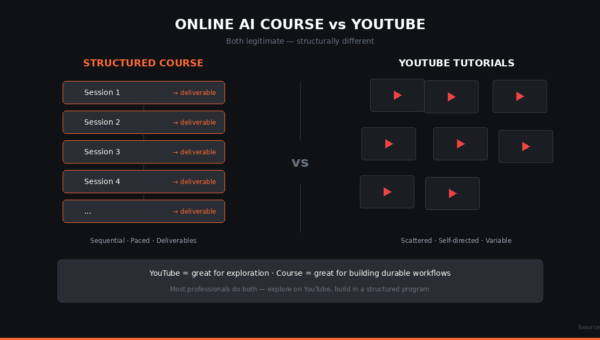
- Online AI course vs. YouTube tutorials — When to use each, how most fluent professionals combine them.
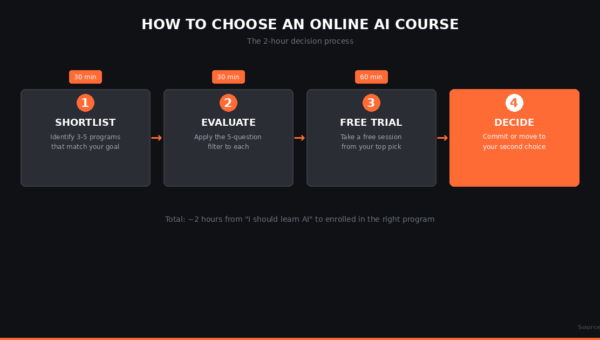
- How to choose an online AI course: the 2-hour decision process — Skip the analysis paralysis; structured shortlist → evaluate → trial → decide.
- Self-paced vs. cohort-based AI courses — Plus the third format (agent-paced) that resolves the trade-off.
SourceLab’s approach (and where it fits in the landscape)
SourceLab AI Studios is one of many programs in this space — specifically, an agent-paced format. Our 8-session AI Edge track is built for non-technical working professionals. The AI instructor agent paces each session. Each session ends with a real deliverable tied to participants’ actual work — Session 1 in particular has you bring in one task you need to do (an email, meeting notes, a description, a process doc) and walk out with it done.
That’s our shape. Several other formats and providers may fit your situation better — Coursera and Udemy work for highly self-directed learners; cohort programs work for people who want peer accountability; bootcamps work for career-changers becoming engineers. The five-question filter above works for evaluating any of them, including ours.
Sessions 1 and 2 are free if you want to see the format before paying.
FAQ
Are online AI courses worth it in 2026?
Depends on the format and your discipline. Programs with a pacing structure (cohort, instructor, AI agent, deadline) consistently produce fluency. Open-format async produces fluency only for highly self-directed learners. Pick based on whether you’ll actually finish, not on the marketing.
What’s the best online AI course?
Wrong question. The right question is “which online AI course is best for my goal and my situation?” Use the five-question filter above; the answer changes per person.
How long does an online AI course take?
Varies wildly — from a single 90-minute session to a 12-week bootcamp. For most working professionals, 8-30 hours of structured practice over 1-2 months produces practical fluency. For more on the timeline question, see how long AI training takes.
Are free online AI courses any good?
Some genuinely are — Coursera audit mode, free first sessions of paid programs, well-structured YouTube curricula from credible practitioners. The main issue with free is completion: people who don’t pay don’t have skin in the game, and most don’t finish. Free works if you have unusual discipline or a specific motivating problem.
Can I learn AI without taking an online course at all?
Possible, with the right setup — a real motivating problem, a peer or community for accountability, and a forcing function that requires you to ship something. For more on the DIY question, see can you learn AI on your own.
Is an online AI course better than an in-person bootcamp?
Different goals. Online AI courses (in the broad sense including agent-paced and cohort-based formats) work well for most working professionals. In-person bootcamps work well for career changers becoming AI engineers — and most bootcamps now have remote-cohort options too. Format matters more than online vs. in-person.
See SourceLab in action
SourceLab’s AI Edge track is 8 sessions of 90 minutes each, agent-paced, with sessions 1 and 2 free. No coding required.
Start your first session free →
SourceLab AI Studios is a neighborhood AI learning center based in Mill Valley, CA. Our 8-session AI Edge track teaches working professionals to use AI tools effectively in their actual jobs. Learn more →. For the broader picture on what AI training is in 2026, see our pillar guide.