By SourceLab AI Studios — May 2026
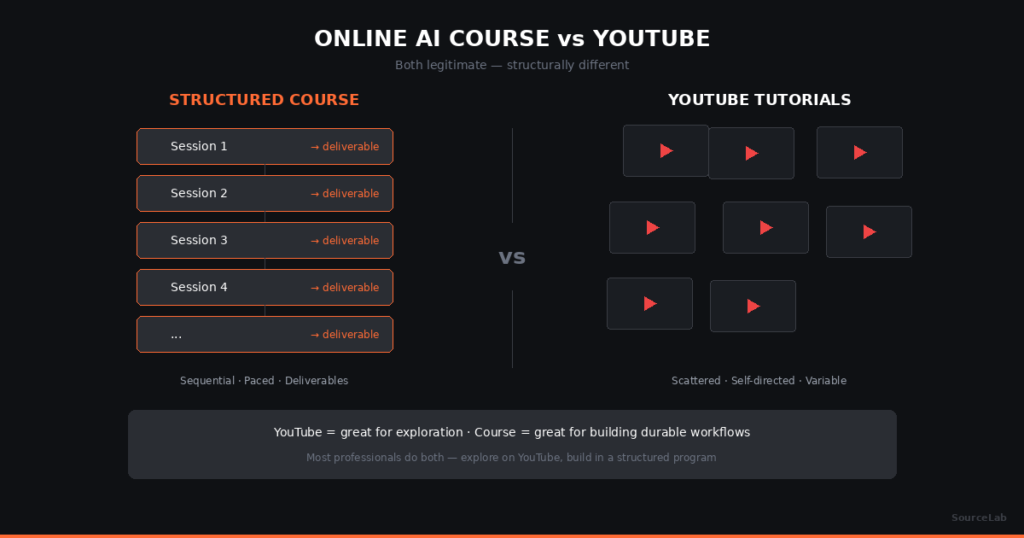
The difference between an online AI course and YouTube tutorials in 2026 isn’t quality — both can be excellent. It’s structure. A course sequences material toward a defined outcome with pacing and (usually) deliverables. YouTube tutorials are a library of standalone how-tos optimized for individual problems. Use a course when you want broad fluency in a category; use YouTube when you have a specific problem and want to solve it now. Most fluent professionals end up using both — courses build the foundation, YouTube becomes the tactical lookup library afterward.
This post is specifically about the structured-course-vs-YouTube format comparison. For the broader DIY question (YouTube plus articles, social, peer learning, self-direction generally), see can you learn AI on your own.
What a structured online AI course does well
Five things courses do that tutorials usually don’t:
- Sequence material. Lesson 2 builds on Lesson 1; you don’t have to figure out the order yourself.
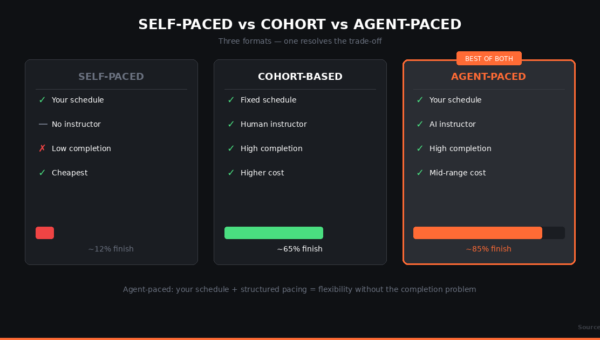
- Set pace. Cohort, instructor, or AI agent keeps you moving. Open-format async courses without pacing perform closer to YouTube on completion (poorly — see Open Praxis, 2024).
- Produce deliverables. Each session ends with something concrete that builds on the previous session.
- Stop when you’re done. Defined endpoint, defined outcome, defined “I can now do X.”
- Provide a support layer. Most reputable courses offer Q&A, instructor feedback, or peer cohort interactions.
The trade-off: courses are slower for solving a specific immediate problem. If you just need to know how to make Claude generate a CSV in a specific format, a course is overkill.
What YouTube tutorials do well
Five things YouTube does that courses usually don’t:
- Solve specific problems fast. Search, find, watch a 10-minute video, apply.
- Cover the latest tools. YouTube creators publish on new releases within days; course curricula update on a slower cycle.
- Show real practitioners. Many top AI YouTube channels are run by people doing AI in production work. The “watch over my shoulder” format is uniquely valuable.
- Cost nothing. No commitment, no payment.
- Cover edge cases. Niche workflows, specific industries, unusual stacks — YouTube has it; courses often don’t.
The trade-off: YouTube doesn’t sequence anything. You can watch 50 hours of AI content and still not have a coherent foundation, because each video assumes a different baseline.
When to pick each
A simple decision rule:
- You don’t have AI fluency yet → online course (preferably structured). YouTube alone tends to produce the “I’ve watched a lot of AI content but I’m not sure I can use it” outcome.
- You have AI fluency and need to solve a specific problem → YouTube. Faster, more targeted.
- You’re learning a new specific tool or workflow → YouTube usually wins because creators publish quickly.
- You’re trying to build broad capability across many tasks → online course wins because of the sequencing.
Most working professionals run both: a structured course produces the foundation, then YouTube becomes the lookup library for specific things that come up.
Why YouTube alone often falls short for foundation building
Three structural reasons:
- No completion logic. YouTube doesn’t tell you “you’ve finished” — there’s always more content. People who try to learn AI exclusively from YouTube often report a lingering feeling of “I’m not done yet” because they never are.
- No application forcing function. YouTube delivers content; it doesn’t require you to apply anything. Watching → applying is the gap that produces fluency, and YouTube doesn’t bridge it.
- Algorithmic distraction. YouTube’s recommendation system surfaces the most clickable content, not the most relevant to your goal. Following the algorithm tends to drift you off the path.
That’s not a knock on YouTube — it’s a description of what the format isn’t built for. YouTube is a library, not a curriculum.
What good combined use looks like
A working pattern most AI-fluent professionals settle into:
- Foundation: structured course (online). Builds the underlying patterns — how to design prompts, how to evaluate outputs, how to think about workflows.
- Tactical layer: YouTube. Specific tools, edge cases, latest releases, unusual workflows.
- Application layer: real work. The actual tasks at your job, where fluency forms.
The mistake is using YouTube as the foundation. The mistake is using a course as the tactical layer. Each format does one thing well; trying to make either do the other’s job underperforms.
SourceLab’s view
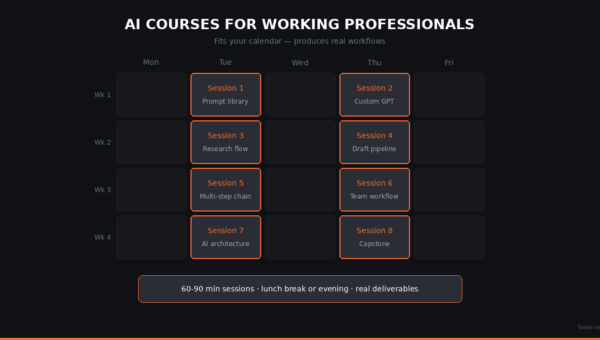
SourceLab’s AI Edge track is in the structured-course category. Eight sessions of 90 minutes each, agent-paced, with sessions 1 and 2 free. The format is designed to produce the foundation that YouTube can’t.
We assume our participants also use YouTube. Most do. The two formats are complementary, not competitive — and we’d rather participants leave with a foundation that makes their YouTube watching more productive afterward than with a stack of tutorials they don’t know how to sequence.
For broader evaluation criteria on online AI courses, see our pillar guide.
FAQ
Can I learn AI entirely from YouTube?
Possible, with the right setup — a specific motivating problem, a learning loop (watch → apply → adjust), and a peer or community for accountability. For most working professionals, structured courses bridge those gaps more efficiently. The broader version of this question is covered in can you learn AI on your own.
What are the best AI YouTube channels in 2026?
Specific channel recommendations go stale fast. The durable filter: practitioners who actually use AI in production work, not pure educators; channels that publish frequently on tool updates; creators who show real workflows rather than abstract demos.
Are paid courses worth more than YouTube if YouTube is free?
The completion data suggests yes for most working professionals. Cost per finished course is the metric that matters, and structured paid programs typically finish at much higher rates than YouTube self-direction.
How much YouTube AI content is too much?
Watching without applying is the trap. A reasonable rule: for every hour of YouTube AI content you watch, spend at least an hour applying what you saw to a real task.
Should I take notes while watching AI YouTube tutorials?
Notes alone don’t produce fluency. The high-leverage move is having a real task open in another window and applying each technique within minutes of seeing it. The retention from “watched + applied immediately” is dramatically higher than “watched + took notes.”
See SourceLab in action
SourceLab’s first two sessions are free — agent-paced, 90 minutes each.
Start your first session free →
SourceLab AI Studios is a neighborhood AI learning center based in Mill Valley, CA. Learn more →. For the broader picture, see our pillar guide on online AI courses in 2026.