By SourceLab AI Studios — May 2026
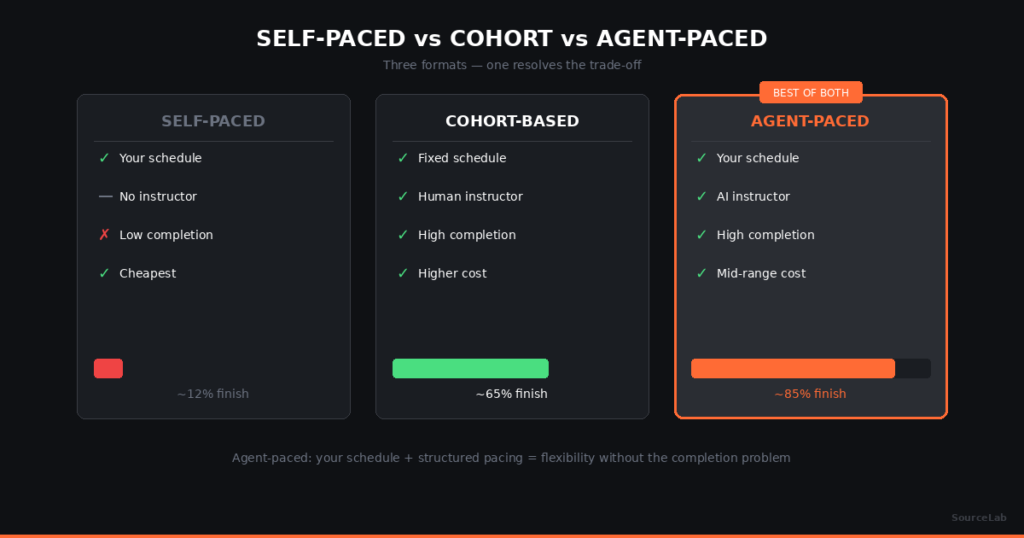
The choice between self-paced and cohort-based AI courses in 2026 isn’t really a binary. Self-paced courses (open-format async, no instructor, no enforced cadence) offer maximum flexibility but have brutal completion rates. Cohort-based courses offer accountability and peer learning but lock you to a fixed schedule. There’s a third option emerging in 2026 — agent-paced learning — that takes the structural benefits of cohort while keeping the flexibility of self-paced. Pick based on your discipline, your schedule, and whether you’ll actually finish.
Most working professionals end up needing both pacing structure and schedule flexibility. The traditional self-paced vs. cohort framing forces a choice between them. The newer agent-paced format dissolves the choice.
What “self-paced” actually means in 2026
The category includes two structurally different things often lumped together:
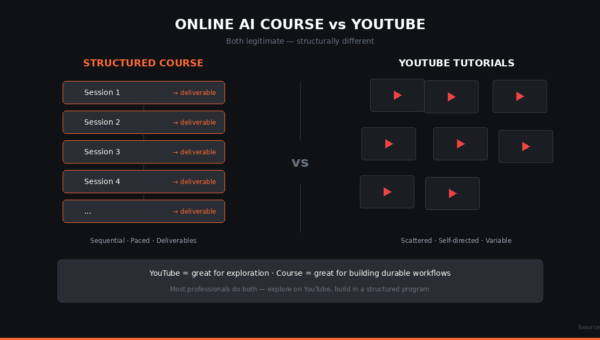
- Open-format asynchronous courses — prerecorded videos, no instructor, no facilitator, no enforced cadence. The Coursera audit-mode and most Udemy course experience falls here. Maximum flexibility, brutal completion: research has found a median completion rate around 12.6% across studied platforms (Open Praxis, 2024), with HarvardX and MITx data showing roughly half of registrants never even start (Inside Higher Ed, 2019).
- Self-scheduled programs with internal pacing — agent-paced or facilitator-paced formats where the participant chooses when to come back, but each session has internal pacing. Looks like self-paced from the outside but performs differently because the format sets the pace once you sit down.
Most discussions of “self-paced” actually mean the first category. Most working professionals would benefit more from the second.
What cohort-based AI courses do well
Five things cohort programs offer that pure async usually doesn’t:
- External pacing. The cohort moves at a fixed cadence; you move with it.
- Peer accountability. A real group of humans expecting you to show up.
- Synchronous interaction. Live discussion, live Q&A, live problem-solving.
- Network effects. Cohort relationships sometimes outlast the course itself.
- Higher completion. Structurally — accountability does the work that willpower can’t.
The trade-off: cohort programs lock you to a fixed schedule. If you need to attend session 4 and you’re traveling that week, you miss session 4. The flexibility of self-paced is real value when life happens.
What agent-paced learning adds in 2026
The newer format — emerging in 2026 — pairs internal pacing with external scheduling flexibility. An AI instructor agent paces each session in real time (asks questions, waits for responses, adjusts difficulty, ensures a deliverable), but the participant chooses when to take each session. Across sessions, you set the schedule. Within sessions, the agent does what an instructor or cohort cadence would do.
Why it’s interesting:
- Pacing structure without schedule lock. The variable that drives completion (internal pacing) is preserved; the variable that breaks busy schedules (synchronous attendance) is removed.
- Personalization at the session level. The agent can adapt to the participant’s pace, prior knowledge, and specific work context in ways a recorded video can’t.
- Available when you can be. Lunch break, weekend morning, whenever — but the session itself is paced once you start.
- Real deliverables tied to real work. Each session ends with something concrete, the same as well-designed cohort programs.
The trade-off: less peer interaction than cohort programs. If community accountability is your motivator, cohort wins. If schedule flexibility is the constraint, agent-paced wins.
Which format actually fits your situation?
Three quick decision rules:
- You have unusual self-direction and a specific motivating problem → self-paced async can work. Otherwise it usually doesn’t.
- You want peer accountability and have a flexible schedule → cohort-based.
- You want pacing structure but have a busy/unpredictable schedule → agent-paced.
For most working professionals, the third option fits best. For most career-changers wanting a peer cohort, the second fits best. For learners with strong self-direction, the first works fine.
Common mistakes choosing between formats
Three patterns:
- Picking self-paced for the price. Cost per finished course is the metric, not headline price. A “free” self-paced course you don’t finish costs more in time than a paid structured program you complete.
- Picking cohort for the prestige. Cohort programs are sometimes more expensive and more “branded.” That doesn’t mean they fit your situation. Schedule lock is a real constraint.
- Assuming “self-paced” means a single thing. Open-format async (no facilitator) and agent-paced learning are both “self-paced” in the sense that you choose when to attend, but they perform very differently. Read the format details, not the marketing label.
The completion math
The variable that determines value in any AI course is whether you finish. Format dictates completion:
- Open-format async (self-paced, no facilitator): ~12.6% median completion
- Cohort-based: dramatically higher (numbers vary, but consistently outperform async)
- Agent-paced: designed to address the completion problem in async; emerging data suggests strong performance, structurally similar logic to cohort
Pick the format that gets you to “finished.” Whatever curriculum you didn’t finish wasn’t worth it, regardless of how good it was on paper.
SourceLab’s format
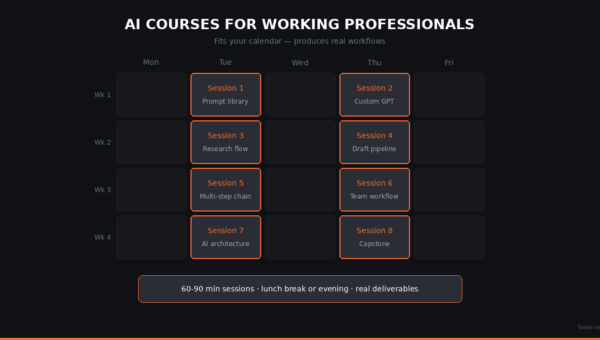
SourceLab’s AI Edge track is in the agent-paced category. The AI instructor agent paces each session — keeps participants moving, adjusts to their pace, ensures a deliverable comes out — while participants choose when to take each session. Eight sessions of 90 minutes each, completed in 1-2 months on a flexible schedule. Sessions 1 and 2 are free.
That’s our shape. Several reputable cohort programs and self-paced async programs may fit your situation better. The question isn’t “which format is best” — it’s “which format will I actually finish, and what will I have built when I do?”
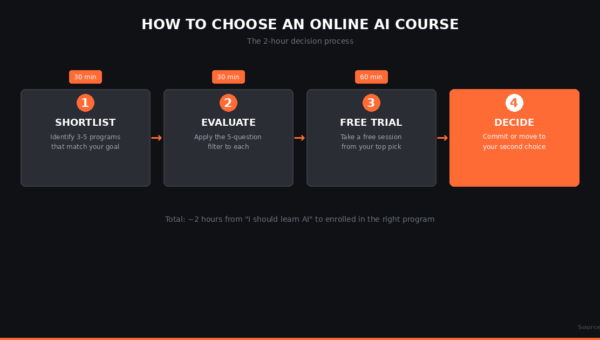
For broader evaluation criteria, see our pillar guide on online AI courses.
FAQ
Is self-paced or cohort better for AI training?
Better for what? Self-paced async works for highly self-directed learners with a specific problem and a forcing function. Cohort works for people who want peer accountability and have a flexible schedule. Most working professionals fit neither perfectly — agent-paced is the format designed for them.
Can I switch from self-paced to cohort partway through?
Most programs don’t allow mid-stream format swaps. The honest move is to pick the format that fits your situation upfront. If self-paced isn’t working at week 3, the answer usually isn’t to switch programs — it’s to add a forcing function (a deadline, a peer, a project that requires what you’re learning).
What’s the cheapest format that actually produces fluency?
Free first sessions of agent-paced or cohort programs. The format does the work; the price is zero (for the trial). After the trial, paid structured programs in the $100-500 range tend to be the sweet spot for non-developers.
Are cohort-based AI courses worth the higher price?
For people who fit the cohort format (flexible schedule + value peer accountability), yes — completion rates and outcomes justify the price. For people who can’t reliably attend a fixed cohort schedule, the higher price doesn’t translate to outcomes.
Is agent-paced learning the same as having a chatbot help me?
No. A chatbot answers questions you ask; an AI instructor agent paces a structured session — asks you questions, waits for your responses, adjusts difficulty, makes sure each session ends with a real deliverable. The difference is whether the AI is reactive (chatbot) or guides the experience (agent).
See SourceLab in action
SourceLab is agent-paced — pacing structure inside each session, schedule flexibility across them. First two sessions free.
Start your first session free →
SourceLab AI Studios is a neighborhood AI learning center based in Mill Valley, CA. Learn more →. For the broader picture, see our pillar guide on online AI courses in 2026.