By SourceLab AI Studios — May 2026
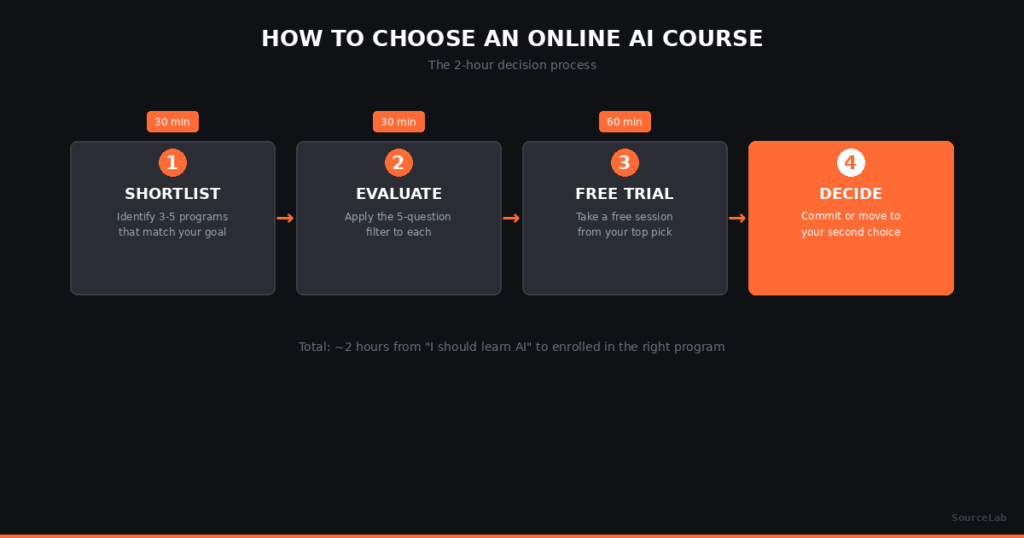
Choosing an online AI course in 2026 should take about two hours. Not two weeks of reading reviews, not two months of “researching.” The actual decision is fast if you follow a structured process: 30 minutes to shortlist, 30 minutes to evaluate, 60 minutes inside a free trial. Most working professionals get stuck in evaluation paralysis because they’re trying to compare every program in the market against every criterion. The fix is process discipline — narrow first, evaluate against a stable framework, then test the top candidate in the actual format. The framework itself is straightforward (covered in our pillar guide on online AI courses and our criteria for the best AI training for non-developers). This post is about how to apply it efficiently.
The bottleneck in choosing an AI course usually isn’t information. It’s process.
Step 1: Shortlist in 30 minutes
Most working professionals start by trying to consider every program. That’s a trap — the AI training market has hundreds of programs that all sound similar in marketing. Skip the wide search.
Pick 3-5 programs from these sources:
- 1-2 programs from a specific search query that fits your role (“AI training for project managers,” “online AI course for marketers”)
- 1 program someone you trust has actually completed (not just signed up for)
- 1 program from a known structured-format provider in your ecosystem (your employer’s LMS, an industry association you belong to, a network you trust)
- Optionally 1 wild-card program you keep seeing ads for and are curious about
Stop at five. More options doesn’t produce better decisions; it produces analysis paralysis.
Step 2: Apply the framework in 30 minutes
The evaluation framework — covered in detail in our pillar guide on online AI courses and the non-developer criteria post — comes down to five questions: pacing structure, concrete deliverables, current curriculum, free trial path, support layer.
For each of your 3-5 shortlisted programs, pull up their main course page and answer all five questions from public materials. About 5-6 minutes per program.
What to look for as you do this:
- If you can’t answer a question from public materials: that’s data. Programs that hide their format usually have weak format.
- If the marketing copy is identical across all five programs: ignore the marketing and look at the curriculum directly. Marketing converges across the category; substance differentiates.
- If a program scores well on four of five questions: advance it to the next step. Five-for-five is rare and usually unnecessary.
By the end of Step 2 you should have 1-2 programs worth testing — not zero, not five.
Step 3: Take the free trial of 1-2 programs in 60-90 minutes
Most reputable structured AI programs offer free first sessions specifically so you can evaluate the format before paying. Use them.
Block 60-90 minutes per trial. Don’t multitask. Treat the free session like a paid one — bring a real task, do the work, see what comes out.
What to evaluate during the trial:
- Pace. Does the format keep you moving or do you find yourself drifting? Pacing structure is the variable that most predicts whether you’ll finish.
- Tie to your real work. Does the session ask you to bring something specific from your actual job, or does it teach in the abstract? Specific tie-in produces fluency; abstract instruction produces tutorial-watching.
- Deliverable. Did you leave with something you can use this week? If not, the format may not produce the kind of fluency you need.
- Friction points. What got in your way? If small things irritated you in the first session, they’ll compound across 8 more.
After the trial, you’ll usually have a clear preference. If both trials felt strong, pick the one that fit your schedule better. If neither did, do a third trial — but don’t try to test more than three.
What to skip in the process
A few things that consume time without improving the decision:
- Reading 20+ reviews. Reviews tell you what worked for someone else, not what works for what you’re trying to do. Skim a couple for major red flags; don’t sink hours into them.
- Building a comparison spreadsheet. Almost always over-engineering. The five-question framework already does this work.
- Asking for opinions in 5 different forums. Decision paralysis amplifies. Three trusted sources max.
- Waiting for the “perfect” program. AI tools are evolving faster than course curricula. The cost of waiting another month often exceeds the cost of starting with a strong-but-imperfect option.
Common mistakes in the decision process
Three patterns that turn a 2-hour decision into a 2-week procrastination:
- Treating it as a high-stakes one-shot decision. It’s not. If the first program doesn’t fit, switch. Most working professionals can absorb a single $200-500 program-fit mistake; what they can’t absorb is six months of indecision.
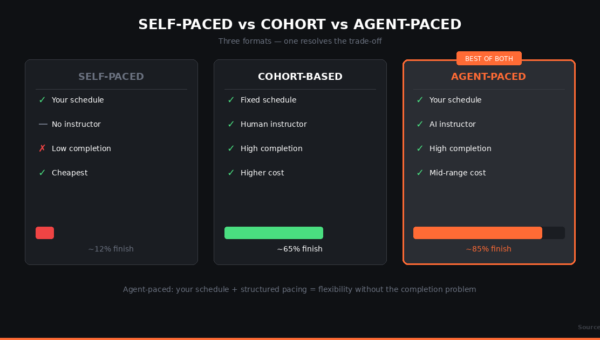
- Optimizing for the cheapest option. Cost per finished course is the metric, not headline price. The completion data favors paid structured formats over free open-format async.
- Picking the most popular option without testing fit. Popularity isn’t a great proxy for fit. Run the framework, not the popularity contest.
When to walk away (instead of choosing one)
A few signals that none of the shortlisted programs is the right fit yet:
- All five programs fail on pacing structure → you’re looking at the wrong format category. Re-shortlist with structured-format providers.
- The free trials all felt generic → you may need to look at role-specific programs rather than generic AI training.
- You can’t articulate the specific work problem you want AI to solve → take a step back. Self-clarification before tool selection. (See should I take AI training at all for the upstream question.)
SourceLab’s case
SourceLab’s AI Edge track is one option you’d shortlist for non-technical working professionals. Sessions 1 and 2 are free — the natural step-3 trial for this process. We’d want you to also free-trial 1-2 other programs alongside it; the framework above works for any of them.
FAQ
How do I find programs’ session lists to evaluate?
Most reputable programs publish session-by-session curriculum on their main course page. If you can’t find one, email and ask. Programs that won’t share their curriculum publicly are a yellow flag.
Is two hours really enough to choose?
For most working professionals, yes — if the time is focused. Two hours spread across two weeks of background research isn’t the same as two hours of structured decision-making. Block the time.
What if I’m not sure what kind of AI fluency I need?
Take a free trial of one program before you’ve finalized your goals. The trial often clarifies the goals. Doing it the other way (“I’ll figure out my goals first, then evaluate programs”) tends to produce indefinite delay.
Should I take multiple AI courses?
Eventually, probably — AI evolves fast. But sequentially, not concurrently. Stockpiling enrollments has the worst completion rate of all.
What if I choose wrong?
You probably won’t, if you ran the trial. If you do, switch. The cost of one wrong $200-500 program is much smaller than the cost of six months of indecision.
See SourceLab in action
SourceLab’s first two sessions are free — the natural step-3 trial. No credit card. Bring one real task.
Start your first session free →
SourceLab AI Studios is a neighborhood AI learning center based in Mill Valley, CA. Learn more →. For the broader picture, see our pillar guide on online AI courses in 2026.