By SourceLab AI Studios — May 2026
The right online AI course for a working professional in 2026 fits three constraints: it produces immediately applicable workflows (not theory), it fits a full-time schedule (60-90 minute sessions, twice a week or less), and it has enough structure to actually finish. The best fit for most non-technical working professionals is a multi-session structured program (agent-paced or facilitator-paced) spread over 1-2 months. Bootcamps are designed for career-changers; open-format async courses have brutal completion rates against busy schedules. The middle tier produces the best ROI for people who already have full-time jobs.
The category has matured fast. McKinsey reports that AI usage at work jumped from 30% in 2023 to 76% by 2025, and the number of jobs explicitly requiring AI fluency grew sevenfold (McKinsey, 2025). The supply has caught up — but unevenly. Working professionals need to filter sharper than casual learners.
What working professionals actually need from an online AI course
Five features map to the constraints of a full-time job:
- Short, defended sessions. 60-90 minutes is the sustainable unit for most working professionals. Sessions that demand 3+ hours of continuous focus tend to slip when work gets busy.
- Workflow integration over theory. A course that produces a Custom GPT for your weekly status reports beats a course that explains transformers, for the working-professional audience.
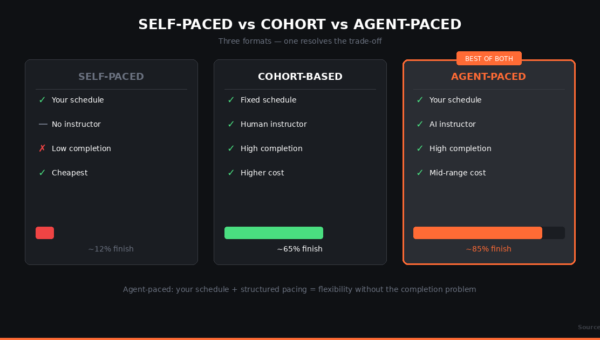
- Pacing structure that doesn’t depend on willpower. Agent-paced or cohort-based formats outperform open-format async because the pacing is external. After a busy week, willpower is the wrong thing to rely on.
- Recent curriculum. AI changes fast; a 2024 curriculum may reference tools that have been replaced. Look for visible signs of updates within the past 6-12 months.
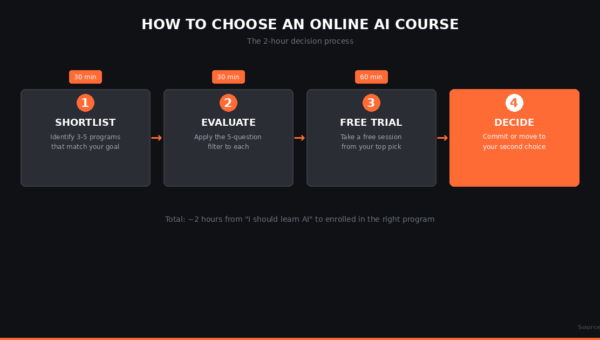
- A free trial. Lets you evaluate the format against your real schedule before committing money or time.
Schedules that work for full-time professionals
Three cadences that consistently fit:
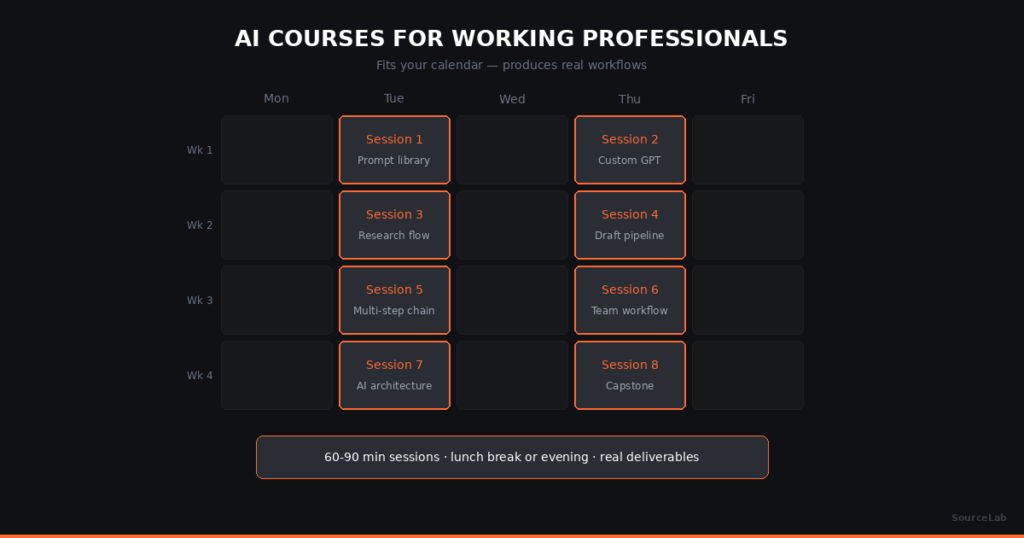
- The lunch-break cadence. 60-minute sessions twice a week during lunch. Easiest to defend on the calendar. Total elapsed: 6-8 weeks for an 8-12 session program.
- The weekend-anchored cadence. One 90-minute Saturday or Sunday morning session per week, plus one shorter weekday practice block. Total elapsed: 8-12 weeks.
- The intensive cadence. Two 90-minute sessions per week for 4-6 weeks. Faster, more concentrated, but burns out more participants when work spikes.
The lunch-break cadence is the most sustainable across most jobs. The intensive cadence produces fluency fastest if your calendar can hold it. Pick based on which you’ll actually maintain.
What to skip if you have a full-time job
Three patterns that consistently underperform for working professionals:
- Open-format asynchronous courses with no facilitator. Median MOOC completion rates around 12.6%. The format relies on self-direction that busy professionals usually can’t sustain.
- AI bootcamps marketed for “career changers” you’re not. If you’re upgrading your current role rather than switching to AI engineering, the bootcamp format is overkill — too long, too expensive, too coding-heavy. See our breakdown of AI training vs. AI bootcamps.
- 40+ hour comprehensive courses. Even broken into modules, these tend to slip and never finish. Smaller, structured programs you actually complete produce more fluency than longer programs you don’t.
Online AI courses by role
Different roles benefit from different course emphases. A few quick mappings (most reputable structured programs cover these in customized session paths or cohort tracks):
- Project managers — workflows for status reports, stakeholder communication, project research, retrospective analysis.
- Marketing & communications — content drafting, audience research, A/B copy generation, social listening.
- Sales — prospect research, outreach personalization, call notes synthesis, CRM-ready summaries.
- Operations & admin — process documentation, recurring report automation, vendor research, scheduling helpers.
- HR & people ops — interview prep, job description drafting, policy plain-language translation, performance review structuring.
- Finance — variance analysis narratives, board memo drafting, Excel model explanations, vendor comparison summaries.
Programs that have role-specific tracks (or facilitators who can adapt sessions to your job) consistently outperform generic curricula for working professionals.
What good ROI looks like
A working professional taking an online AI course that fits will typically see:
- Within 24 hours of session 1: one concrete deliverable they’re using at work (a prompt library, a Custom GPT, a workflow).
- Within 4-6 sessions: AI fluency at the level of “I use it daily, multiple tasks, without thinking about it.”
- Within 8-12 sessions: architecture-level thinking — building reusable AI assets that travel across tools, jobs, and timeframes.
For more on the timeline question, see how long AI training takes. For the ROI math, see is AI training worth it in 2026.
SourceLab’s fit for working professionals
SourceLab’s AI Edge track is built specifically for working professionals 28-55 in non-technical roles. Eight sessions of 90 minutes each, agent-paced, completed in 1-2 months. Sessions 1 and 2 are free. The AI instructor agent sets the pace within each session; the participant chooses when to come back between sessions. That structure fits the lunch-break cadence and the weekend-anchored cadence equally well.
Other formats may fit your specific situation better. For evaluating any program, the five-question framework in our pillar guide works.
FAQ
Can I take an online AI course while working full-time?
Yes — most structured AI training is built for working professionals. The 8-12 session shape with 60-90 minute sessions is specifically designed to fit alongside a full-time job.
What’s the most efficient online AI course for a busy professional?
The most efficient is also typically the most structured: programs with agent-paced or facilitator-paced sessions, concrete deliverables, and a defined sequence. Open-format async looks efficient on paper but fails most working professionals on completion.
Will my employer pay for an online AI course?
Increasingly, yes. Many companies have learning and development budgets that cover AI training. Bring your manager a specific program with a clear deliverable plan (“after sessions 1-3 I’ll have built X workflow”). The conversation goes better than asking for a vague “AI course.”
Should I tell my company I’m taking an AI course?
Usually yes — particularly if your role uses AI. Visible AI fluency is increasingly a career asset. Quiet AI fluency leaves the value on the table.
How long until I see ROI?
Most working professionals build a workflow in their first session that they start using within 24 hours. Full ROI compounds across the program.
See SourceLab in action
SourceLab’s AI Edge track is 8 sessions for working professionals. First two free.
Start your first session free →
SourceLab AI Studios is a neighborhood AI learning center based in Mill Valley, CA. Learn more →. For the broader picture, see our pillar guide on online AI courses in 2026.