By SourceLab AI Studios — May 2026
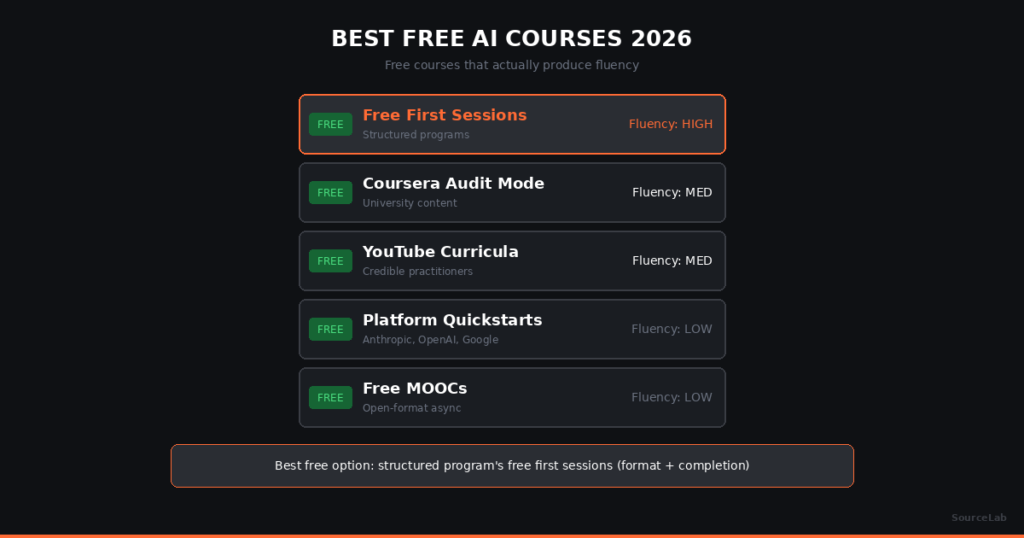
The best free AI courses in 2026 fall into three categories: free first sessions of paid structured programs (highest completion, highest fluency), credible free curriculum from authoritative sources like Anthropic, OpenAI, Google, and the major universities (good for tool literacy), and YouTube curricula from practitioners who actually use AI in production work (variable quality, good for specific tactics). What makes a free course “best” isn’t the curriculum — it’s whether you’ll actually finish it.
Free is more of a format question than a content question. The completion-rate research is unforgiving on open-format async courses regardless of price. A free course you don’t finish is worth less than a paid one you do.
What counts as a “free AI course” in 2026?
Five common formats:
- Free first sessions of paid programs. Most reputable structured AI programs offer the first session or two free so you can evaluate the format. Highest completion rates because the structure is the same as the paid version.
- Coursera audit mode. Free access to course videos and reading materials; paid for graded assignments and certificates. Strong curriculum from credible providers (Stanford, DeepLearning.AI, Google), open-format async without the certificate path.
- edX free courses. Similar audit-mode pattern. MIT, Harvard, and others offer credible AI fundamentals.
- YouTube curricula. Practitioner-led series on specific topics (prompt engineering, Claude workflows, ChatGPT for specific roles). Variable quality; good ones are excellent, bad ones waste time.
- Vendor onboarding content. Anthropic, OpenAI, Google, and Microsoft publish free getting-started materials for their AI products. Tool-specific, useful for getting up the curve on a particular product.
Which free AI courses actually produce fluency?
The honest filter:
- For tool literacy (knowing what ChatGPT/Claude/Copilot can do): YouTube curricula from credible practitioners + vendor onboarding content. Free is fine here because the bar is low and the content is well-suited to async consumption.
- For workflow integration (using AI to handle real recurring tasks at work): free first sessions of structured programs. The format does the work that pure-async courses can’t.
- For foundations and theory (how AI models actually work under the hood): Coursera audit mode + edX free courses + Stanford/MIT/CMU course websites. Strong content, requires self-direction.
If your goal is workflow integration — which it is for most working professionals — the highest-leverage free option is the free first sessions of paid structured programs. The format is the variable that matters.
Why most free AI courses fall short of paid ones
Three structural reasons:
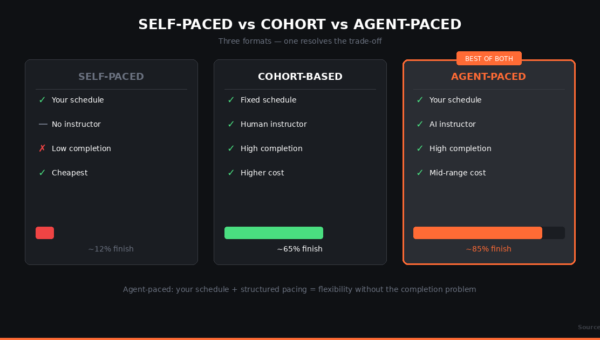
- Open-format async without payment doesn’t have a finish-line forcing function. The completion-rate research has found a median completion rate around 12.6% across studied platforms (Open Praxis, 2024). HarvardX and MITx data showed roughly half of registrants never even start the course they signed up for (Inside Higher Ed, 2019). Free amplifies this — no commitment, no finish.
- Free curriculum often lacks personalized application. Generic content (“here’s how prompt engineering works”) doesn’t get tied to your specific job tasks the way paid structured programs do.
- Free typically has no support layer. No instructor, no peer cohort, no Q&A channel — when you get stuck, you stay stuck.
That’s not a knock on free as a category — it’s an honest description of the trade-off. Free works when you have unusual self-direction, a specific motivating problem, and a forcing function. For most working professionals, free first sessions of paid programs are the better free path.
How to make a free AI course actually worth it
Three things help any free course produce fluency:
- Have a specific motivating problem. Not “learn AI” — “use AI to handle the weekly status report I write every Monday.” A specific problem creates a forcing function the course can serve.
- Set a deadline. A real one tied to something real (a project at work, a presentation, a job interview). Free courses without external deadlines tend to slip indefinitely.
- Apply each lesson within 24 hours. Watching → trying is the gap that produces actual fluency. Watching → forgetting is the default.
If you can set up those three, free works. If not, structure (paid or free first sessions of paid) does the work for you.
What to skip
Patterns that consistently produce low ROI:
- Stockpiling free courses. Enrolling in 5 free courses you don’t finish is worse than completing 1.
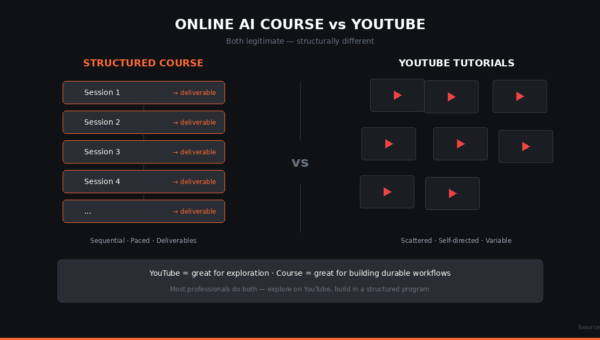
- Pure tutorial-watching with no application. YouTube has thousands of hours of AI content. None of it produces fluency on its own.
- Generic “AI fundamentals” courses without tie-in to your real work. Knowledge without application fades fast.
SourceLab’s free option
SourceLab’s AI Edge track offers Sessions 1 and 2 free. Same agent-paced format as the paid sessions — the AI instructor agent paces you through real work. No credit card required. After session 2, $25/session or $175 for the full track if you want to keep going.
That’s how we’d structure a free trial of any worth-it AI course: enough to evaluate the format and produce something useful, but not so much that the program loses its commercial model. If a “free” program shows you everything for free, the value math doesn’t work — and that often shows up as low quality. Free first sessions of paid structured programs tend to outperform fully-free open-format async on the metric that matters: completion.
FAQ
Is Coursera audit mode actually free and worth it?
Yes, Coursera’s audit mode is genuinely free for most courses (you can access videos and most readings; certificates and graded assignments cost extra). The content quality is generally strong because the courses come from credible providers. The completion problem applies — most auditors don’t finish.
What free AI courses do practitioners actually recommend?
Specific recommendations go stale fast in this category. The durable answer: free first sessions of structured programs you’re considering paying for, vendor-published guides for tools you actually use (Anthropic, OpenAI, Google, Microsoft), and curated YouTube playlists from practitioners with production experience.
Can I learn AI for work entirely on free courses?
Possible, but uncommon. Working professionals who succeed without paying have a specific motivating problem, a peer or community for accountability, and a forcing function. For more on the DIY question, see can you learn AI on your own.
Are free AI bootcamps a thing?
Some scholarship-funded or sponsor-funded bootcamps exist, particularly for underrepresented groups in tech. They’re harder to find but worth searching for if you fit the eligibility criteria. Most reputable bootcamps charge market rates because the format is high-touch.
What’s the difference between a free AI course and a free AI tutorial?
“Course” implies a structured curriculum with sequencing; “tutorial” implies a standalone how-to. Both can be free. For learning a category of skill, courses tend to outperform unconnected tutorials. For solving a specific problem, a focused tutorial often beats a broad course.
See SourceLab in action
SourceLab’s first two sessions are free — no credit card. Real deliverable in your first session.
Start your first session free →
SourceLab AI Studios is a neighborhood AI learning center based in Mill Valley, CA. Learn more →. For the broader picture, see our pillar guide on online AI courses in 2026.